Sophrology: the mind-body practice designed to regulate your nervous system and combat chronic stress
Struggling with stress? Try this daily method to soothe your nervous system
By 

Feeling overwhelmed by chronic stress? Soothe your nervous system with this daily mind-body practice that combines gentle movement with breathwork and visualisation.
The endless hustle and bustle of modern life can send your nervous system into overdrive. If you’re feeling stuck, overwhelmed or disconnected from your mind and body, Sophrology could help you to press pause and tune back in.
‘Sophrology is a structured mind-body practice that combines breathing techniques, gentle movement, relaxation, visualisation and body awareness,’ explains Dominique Antiglio, Sophrologist and founder of online Sophrology platform BeSophro. ‘What makes it unique is that it actively works with both the body and the mind. Rather than trying to stop thoughts or empty the mind, you use simple techniques to strengthen your awareness of what is happening internally and learn how to respond more consciously to life’s challenges.’
While Sophrology has gained considerable momentum in recent years, it’s far from being a new technique. ‘It was developed by neuropsychiatrist Professor Alfonso Caycedo in the 1960s, who designed it to help people develop greater self-awareness, resilience and wellbeing,’ Dominique explains. ‘Today, it is widely practised and is often prescribed alongside traditional medical solutions, as a practical tool for managing stress, improving sleep and supporting emotional balance.’

How Sophrology is combatting the modern stress epidemic
The normalisation of daily stress sees millions prioritising productivity and responsibilities over rest and wellbeing. ‘Many of us have become so accustomed to living with stress that we barely notice it anymore,’ explains Dominique. ‘We push through busy schedules, spend hours in front of screens and move quickly from one responsibility to the next. Over time, this can leave us feeling disconnected from our bodies, mentally fatigued and stuck in a constant state of alertness.’
While temporary stress can aid with focus and concentration, prolonged or chronic stress can begin to heavily impact your life over time. ‘When we experience stress, our nervous system naturally shifts into a state of heightened vigilance,’ she adds. ‘This can be helpful in short bursts, but many people spend so much time in this state that it begins to affect their sleep, concentration, mood and energy levels.’
If you feel stuck in an endless cycle of stress, the movement, breathwork and visualisation techniques of Sophrology can help you to carve out pockets of time for introspection and awareness. ‘Sophrology creates moments of regulation throughout the day, encouraging the body and mind to move away from survival mode and towards a greater sense of balance and ease,’ Dominique tells us.
When practised regularly, it can also help you to become more attuned to how stress shows up in your body. ‘One of the most valuable things Sophrology teaches is how to recognise the early signs of stress,’ she continues. ‘Often, our bodies are communicating with us long before we consciously acknowledge that we are overwhelmed. Tight shoulders, shallow breathing, jaw tension or a racing mind can all be signals that the nervous system needs support.’
Getting started with Sophrology
When starting out with Sophrology, it’s important to remember that it is a practice – meaning it will take time to build your skills, develop your self-awareness and train your mind and body to relax. ‘For those who are completely new to Sophrology, the most important thing is to start small,’ says Dominique. ‘Even five or ten minutes a day can make a meaningful difference. Consistency is far more valuable than intensity. The goal is not to perform perfectly, but to gradually build a stronger relationship with yourself and your internal resources.’
Rather than doing the occasional Sophrology session here and there, Dominique recommends trying to bring the practice into your day-to-day life. ‘I often encourage people to think of Sophrology as a daily hygiene practice for the mind and body,’ she tells us. ‘Just as you brush your teeth to maintain physical health, taking a few minutes to consciously regulate your nervous system can help you feel calmer, shift your perspective and help you be more resilient and better equipped to navigate everyday life.’
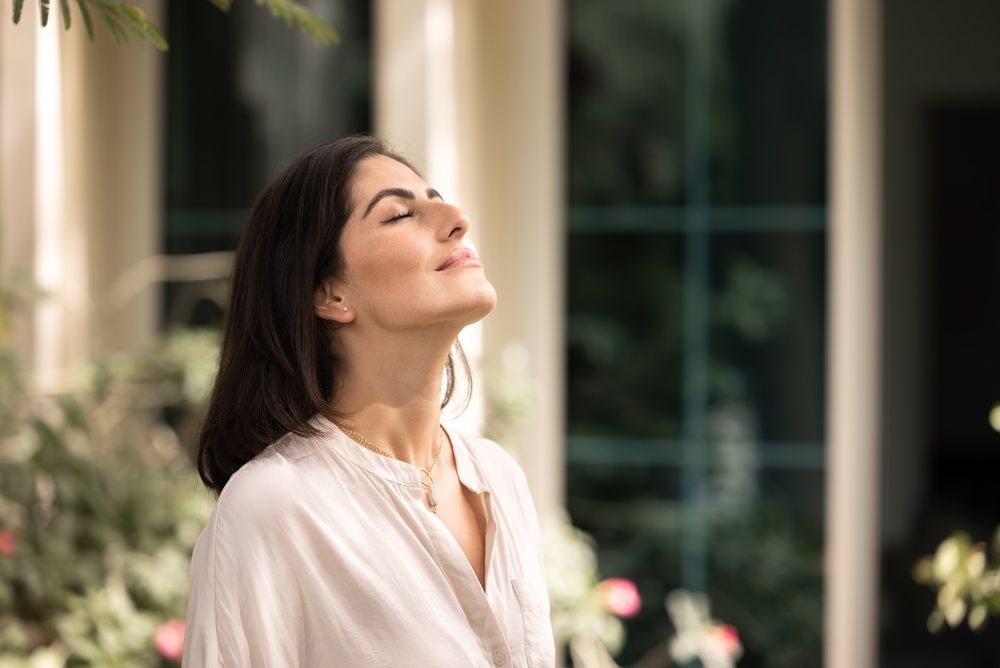
Try this Sophrology technique for a nervous system reset:
Dominique recommends starting with a Sophrology exercise called ‘The Pump’. Here’s how to do it:
1. Begin by standing comfortably with your arms relaxed by your sides and take a moment to notice how you feel physically, mentally and emotionally.
2. Gently clench your fists, inhale through the nose and hold the breath for a few seconds while pumping your shoulders up and down.
3. Now, exhale through the mouth, releasing your arms and hands completely as though you are letting go of any tension you have been carrying.
4. Pause and notice the difference before repeating the exercise two or three times.
‘This technique may seem deceptively simple, but it can be remarkably effective,’ Dominique explains. ‘The combination of movement, breath and intention helps release physical tension, interrupt mental overactivity and bring your attention back into the present moment.’
‘Over time, using simple body activation techniques – of which Sophrology has many – is also a way to develop deeper body awareness,’ she continues. ‘This allows you to stay connected to the body even through moments of stress, which ultimately helps with regulation.’
‘Overall, Sophrology reminds us that while we cannot always control external circumstances, we can learn to influence how we experience them,’ Dominique concludes. ‘Through regular practice, we develop a greater sense of presence, adaptability and trust in our ability to cope with whatever life brings.’
Dominique Antiglio is a master Sophrologist, wellbeing expert and founder of online Sophrology platform BeSophro. Discover more daily Sophrology practices via the BeSophro app.