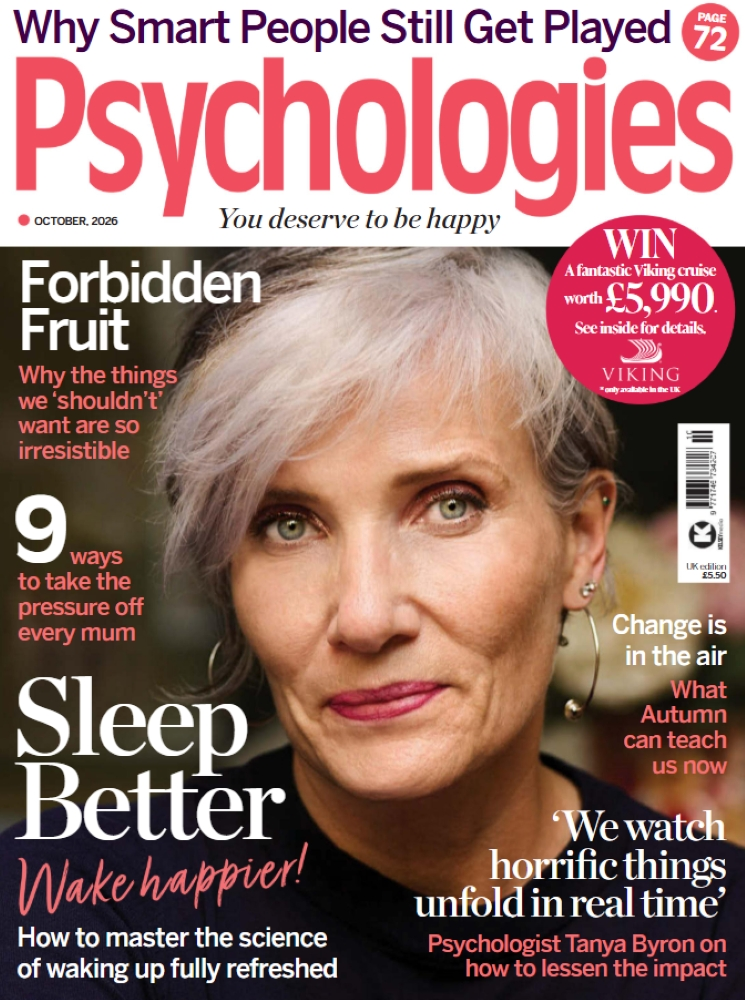
Feeling helpless about the state of the world? How to stay informed without burning out emotionally
Psychologists explain why the news can leave us feeling anxious, angry or powerless —and how to find a healthier balance.
 Sally Saunders

Words: Kellie Gillespie-Wright. Images: Shutterstock.
Every day brings a new headline: war, genocide, soaring inflation, social fracture, political collapse, and the resurgence of the far right. The crises seem endless, each one stacked on the last, and even when the events are unfolding far from home, the psychological toll is immediate and often overwhelming.
With 24-hour rolling news and constant access to updates through our phones, the stream of information rarely stops long enough for mond of body to recover. It’s no wonder a growing number of people across the UK are feeling the emotional strain of constant global crisis.
‘We are living in an environment our nervous systems simply weren’t designed for,’ says Dr Sophie Mort, clinical psychologist and author of A Manual for Being Human. ‘An almost constant stream of distressing, often horrifying news. Each headline registers as a potential threat, activating our fight, flight, freeze system. In small bursts that system is protective, but when it’s triggered over and over, with no pause to recover, people get stuck in a state of chronic reactivity. The body remains braced, the mind alert, and we never quite come down.’
On top of that physical strain sits something more psychological. ‘We are bombarded not only with atrocities, but also with a breakdown in shared reality,’ says Dr Mort. ‘People swear black is black while others are equally certain black is white. AI-generated images and videos flood our feeds, eroding our confidence in even our own eyes. Trust, which is integral to feeling safe and well, becomes harder to locate. Without trust and certainty, the world feels unstable at its core, and our nervous systems keep scanning for danger.’
One of the most destabilising feelings in this climate is a sense of urgent responsibility; the instinct to do something in the face of so much suffering. As Dr Mort explains, ‘When we see injustice or suffering, our survival instincts push us to act, to try to stop it. But often when we do act, nothing seems to change or change is painfully slow, or political leaders tell us nothing can or will be done.
‘The energy that initially helped us cope by fuelling action suddenly has nowhere to go. Instead of relief, we feel doubled stress: we see the problem, we feel the danger, but we also feel powerless to alter it. That helplessness can be even more overwhelming than the original fear. And all of this is before we even touch on the personal fallout: disagreements with friends, family, or colleagues who see events differently.
‘Conflicting world-views can fracture relationships and add yet another layer of stress, because the very people we would usually turn to for support may no longer feel safe or aligned. Taken together, it is no wonder so many people feel over-revved, overstimulated, and stuck in survival mode.’
Entering survival mode
For many, that survival mode becomes the new baseline. ‘Survival mode is what happens when the nervous system never gets to reset,’ says Dr Mort. ‘Emotionally, people may feel anxious, irritable, numb, or flooded with grief and rage. Cognitively, you often see racing thoughts, catastrophising, black-and-white thinking, or an inability to focus because so much mental energy is tied up in scanning for danger.
‘Behaviourally, this can look like doomscrolling late into the night, compulsively checking for updates, or swinging between overdrive, trying to fix everything, signing petitions, sharing posts, and paralysis, when it all feels futile.’
This state is made worse, she says, when we hit walls, politically, socially, or interpersonally, that block the impulse to act. ‘What makes this cycle especially corrosive is that the stress response ramps up when action feels blocked. The initial adrenaline of “I must do something” helps people cope, but when they hit a wall (because systems don’t change quickly, because politicians dismiss concerns, or because family members deny what feels undeniable) that stress doesn’t discharge. It multiplies.’
GP, author, and leading mental health broadcaster Dr Radha Modgil sees similar consequences across her clinical and media work. ‘I have certainly noticed over the last five years in all of my different types of work a heightened sense of overwhelm and fatigue that people are experiencing.

‘The level of uncertainty in the world and the global problems it seems in all areas of life that we are facing that has gone on for so long now, that we are all finding our mental and emotional reserves are low. We are having to work harder every single day just to keep our feet on the ground and when that isn’t possible, the result is anxiety and burnout.’
Often, the body shows signs before the mind catches up. ‘People often don’t realise what’s happening because it creeps in slowly,’ she adds. ‘They start sleeping less well, snapping more often, feeling numb or disconnected, or losing interest in things they used to enjoy. They assume it’s just life being busy, but underneath it is a nervous system that never got to rest.’ For many, staying informed can begin as a form of vigilance and end in hypervigilance.
‘There is a real difference, and it often comes down to whether information leaves you grounded or revved up,’ says Dr Mort. ‘Healthy awareness means you check in with the news, you take what you need, and you can then return to your day and your relationships.
‘Hypervigilance is when the nervous system refuses to stand down. You feel compelled to refresh constantly, anxious if you haven’t checked, and even when you’re not actively looking, your mind is rehearsing worst-case scenarios. In the current climate, hypervigilance is intensified by the uncertainty of truth. When you don’t know what is real, or when reality itself is being contested, it feels dangerous to look away because what if you miss the key moment that proves what’s “really” happening? That blurring between vigilance and obsession is how people end up exhausted and despairing.’
She adds, ‘A useful self-check is to ask: “Does staying informed expand my sense of perspective and agency, or does it shrink my world and make me feel unsafe?” If it’s the latter, that’s hypervigilance speaking.’ She also reminds us that repair begins physiologically, not intellectually. ‘The shift begins in the body, not the news feed. If you want to reset your stress response, you need to show your system it’s safe to stand down.’
Bearing witness
Even those with the best intentions can burn out. ‘For many people, especially those with the super-helper mindset, it’s not just about staying informed, it’s about bearing witness,’ says psychologist and author of The Super-Helper Syndrome, Jess Baker. ‘They feel a moral responsibility to see the suffering, to stay connected to the people living through it… Turning away can feel like abandoning them.’ She adds, ‘They might donate, sign petitions, join peaceful protests… yet it never feels enough. That sense of “I should be doing more” becomes heavy, and constant exposure only deepens the emotional toll. It’s compassion without boundaries; all heart, no off-switch.’ Eventually, even awareness feels like a burden.
‘When checking the news stops being a choice and starts feeling like an obligation, when your sleep, mood, or relationships are affected, or when you can’t read a headline without feeling it in your body, that’s a sign your nervous system is on overload.’
Baker encourages reframing the idea of care. ‘The goal isn’t to stop caring, it’s to care in a way that doesn’t break you. Healthy boundaries make your empathy more sustainable. Your emotional bandwidth works like your phone battery. If you leave every app running, you’ll be on 1% by midday.’
So, what does that look like practically? ‘Curate trusted sources,’ Baker continues. ‘Follow a few high-quality outlets or journalists who offer measured reporting. Less noise, more clarity. Set a cut-off time for screens, especially doomscrolling, so your brain isn’t processing disasters right before bed. Read the news on a tablet you leave in the kitchen rather than your phone, so you’re less tempted to check it compulsively.’

Dr Modgil adds, ‘Be clear about what platforms you will use and when and for how long. Sometimes audio or written consumption of the news rather than visual can help us feel less stressed.’ She adds, ‘Write a list of what we can control and what we can’t, and then put our energy into slowly problem-solving. Even though it is against all of our instincts in that survival mode, we need to find ways to slow down and take a step back. This can help us get perspective over what we can manage in any one moment or any one day, and what we can’t.’
Rebuilding agency starts with shrinking the scale. ‘Instead of trying to solve everything, take one small, meaningful step,’ says Dr Mort. ‘Donating, having a compassionate conversation, or resting so you can show up tomorrow. Helplessness grows when we equate action only with massive change.’ And when your reserves are low, remember to reach out.
‘Make sure you ask for support and draw on others’ reserves… Our relationships and friendships are a real safety net in times of overwhelm, so don’t de-prioritise them,’ says Dr Modgil. And if guilt creeps in, remember: ‘The old adage of putting on your own oxygen mask first before helping others is not selfish,’ says Dr Modgil. ‘It is the opposite.’ As Dr Mort says: ‘Resilience doesn’t come from bracing harder against the storm, but from replenishing yourself daily so you can meet the world without burning out.’
How to regain balance
Tips from Ian Stockbridge, Founder of Hope Therapy & Counselling Services
– Name the thought distortion
Notice when your mind jumps to extremes or catastrophising. Quietly name the pattern. Ask: ‘What’s the evidence for this thought? What might I be overlooking?’
– Use self-compassionate reframing
Try gentle internal responses like: ‘It’s normal to feel shaken. I’m doing my best in a difficult moment.’
– Build small, reliable routines
Simple habits can create calm. Have regular wake times, mealtimes, and wind-down periods to anchor your day.
– Introduce a digital sunset
Choose a cut-off time for screens each evening. Use the time to rest, reflect or do something you enjoy.
– Create transition rituals
Mark the end of stressful tasks (or news exposure) with a walk, a cup of tea or a few minutes of stillness.
– Ground yourself in the present
Pause for a sensory reset: notice five things you can see, four you can feel, three you can hear, two you can smell and one you can taste. Or take one deep breath, slowly.
– Check in with your values
Ask: ‘What small act today reflects what matters to me?’ That might be texting a friend, taking a break or supporting a cause.
– Be selective with media
Stick to a few trustworthy sources. Avoid scrolling through feeds that leave you unsettled or angry.
– Notice your limits
If headlines start to hijack your mood, step away. Protect your peace by switching off when needed.
– Balance input with repair
After reading the news, schedule something that restores you: music, movement, connection or rest.
Meet the experts
Dr Sophie Mort is a clinical psychologist, author, and UK mental health expert for Headspace.
Dr Radha Modgil is an NHS GP, broadcaster, columnist and author @dr_radha
Jess Baker is a business psychologist, leadership coach, and author of The Super-Helper Syndrome. jessbaker.co.uk
Ian Stockbridge is a qualified counsellor and leads Hope Therapy & Counselling Services