Crying more during menopause? Here’s why fear and worry increase in midlife – and how to support your emotional wellbeing
Alongside the physical symptoms, menopause can have a huge impact on your emotions. Here's how to spot the signs and support yourself through this new stage of life.
By 

Feeling teary-eyed over the tiniest of things since reaching the menopause? Here’s what’s going on inside your mind and body – and how to support yourself as you navigate this new stage of life.
When people talk about the menopause, they often focus on the physical signs first: the hot flushes, the night sweats, the dry skin. But beneath the surface, many women are also struggling with the mental and emotional sides of menopause. Whether it’s late-night worrying, sudden mood shifts or crying more often, these symptoms might be less immediately obvious, but they can have a huge impact on your day-to-day wellbeing.
‘Do you find yourself crying at the drop of a hat or worrying non-stop about things that didn’t bother you before the menopause?’ asks Eileen Durward, menopause advisor at A.Vogel. ‘This kind of scenario can be very common – and also extremely distressing. It can come on really quickly, even without warning, and if you’re at work or in front of others, it can feel really embarrassing. It’s just one of those really horrible situations that can make you feel totally out of control.’
While you might feel like there is something wrong with you, what you’re experiencing is a common side effect of menopause. Here’s how to spot when menopause might be impacting your emotions – and the steps you can take to support your wellbeing as you navigate this new life stage.
Understanding the hormonal shifts
If your emotions have been feeling all over the place since entering midlife, it’s might be down to changing hormones. ‘As oestrogen falls, it can have a big impact on your emotional ability to keep things under control,’ Eileen explains. ‘As women, we can be very stoic and try to put a brave face on. But during menopause, sometimes that ability just completely disappears and we have no control over our emotions or how we feel.’
If you’re in the early stages of perimenopause, hormones can be particularly turbulent. This can cause sudden mood changes – often without any heads-up whatsoever. ‘When your hormones are still changing, you can get times where your oestrogen can go up and down. This kind of yo-yo effect can really play havoc on your emotional control. And when oestrogen dips – and it can literally do so on the spot – this is when your mood can change without warning.’
Crying more during menopause
Because hormonal changes lower your emotional threshold during menopause, crying can become a more common occurrence. ‘You may find that you can’t watch the news anymore because all the things that are happening in the world will make you sit and cry – or, you may find that you’re crying over nothing,’ Eileen says. ‘Sometimes, you just suddenly feel overwhelmed – and like you want nothing more than to go and shut yourself away for a really good cry.’
As well as crying more often, you might also feel more sensitive or defensive. ‘For example, someone may be jesting with you, and instead of laughing over it, you take it to heart,’ Eileen explains. ‘This can be a big issue in relationships because suddenly, the balance changes and you can’t cope with a partner’s behaviour, or your friends, or even your boss.’
Noticing more fear during midlife
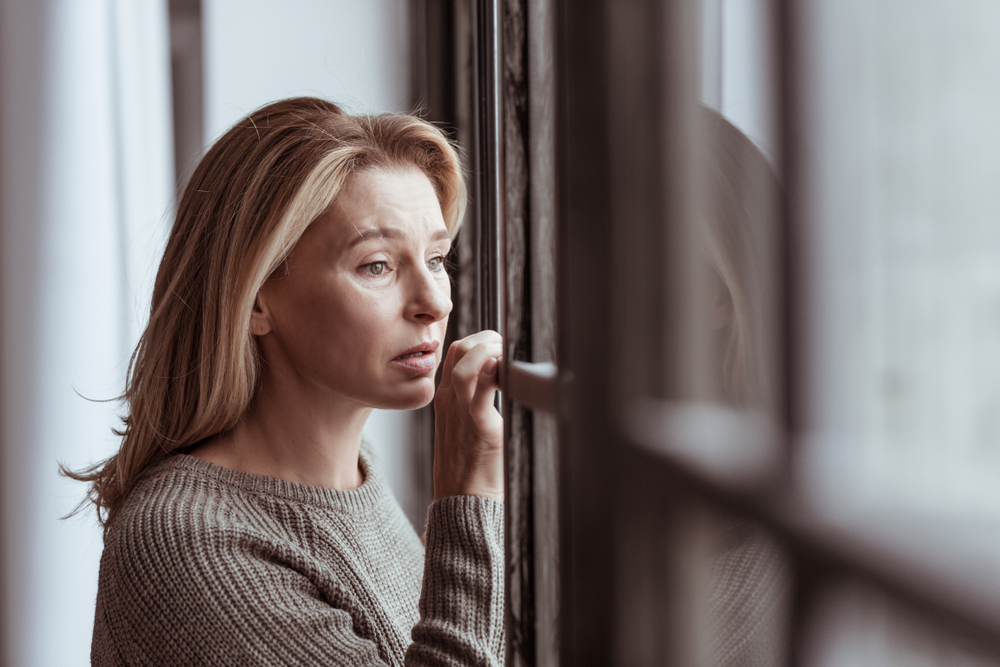
As well as crying more, you might have noticed yourself becoming more fretful during menopause. ‘You might find that you’re fearful of what’s going on in the world, or about something happening to your family,’ says Eileen. ‘You might feel like you can’t find anything uplifting or like there’s this horrible sense of doom and gloom.’
‘One of the common aspects of this is that you might experience the fear first thing in the morning – this can be accompanied by palpitations and shallow breathing,’ she continues. ‘This can be really frightening, because you wake up and suddenly you’re in this state of panic and fear. Your heart’s pumping, the adrenaline’s going, and you’re just feeling this kind of awful, panicky state.’
‘Eventually, your heart and breathing regulate – but you’ve started the day in a state of panic, and sometimes it can take quite a while before everything calms down. And that sets you up in the wrong way sometimes for the rest of the day,’ Eileen adds.
Worrying about the ‘what ifs’
Another feeling you might notice more of in midlife is worry. Rather than the intense moments of panic, dread or impending doom, this is characterised more by an underlying sense of concern and unease in day-to-day life. ‘You might be worrying about things that never used to bother you at all,’ Eileen explains. ‘Maybe you were really confident beforehand, but now you worry about what people are going to think of you, especially at work.’
Alongside feeling uneasy, you might also find your mind being plagued by ‘what if’ scenarios about the future. ‘If there’s something important coming up, you might find yourself playing out every possible scenario word for word, over and over again, maybe for days at a time,’ Eileen adds. ‘Or, maybe you start getting into past worries, looking back and thinking, “oh, I could have handled that differently” or “maybe I shouldn’t have said that”.’

How to support your emotional wellbeing during menopause
If you’ve been feeling more fretful, upset or overwhelmed during the menopause, it’s important to be patient with yourself. Remind yourself that you’re doing your best, despite the fact that your hormones are making it really difficult to regulate your emotions right now.
Below, Eileen has shared her top tips for supporting your emotional wellbeing during this new stage of life – plus some advice on when to seek further support.
Talk about it: ‘You are not going mad here. You are not going out of your head. This is a real physiological situation due to all the hormonal changes going on, so please take heart from that. Explain to your family and friends what’s going on to help them understand why you might be feeling more emotional – that can make a huge amount of difference.’
Support your nervous system: ‘This is very important. If you get your nervous system much more stable and robust, you’re less likely to fall into these types of scenarios. Ways to support your nervous system include staying well hydrated – especially if you are experiencing night sweats and panic first thing in the morning. Certain vitamins and minerals can also really help, including B vitamins and magnesium, which can support your psychological processes and nervous system regulation.’
Cry it out, don’t suppress it: ‘When the urge to cry hits, if you can, go away and have a real good cry because you then get it out. If you suppress it, it’s more likely to just pop up again. Having a real good cry can be very cathartic just on its own.’
When to consult your doctor
If you’ve taken steps to support your wellbeing, but you’re still feeling overwhelmingly upset, worried or tearful, it might be worth seeking some extra support. ‘For most people, these feelings are temporary,’ explains Eileen. ‘But for some, the fear and worry might become all-consuming to the point where you can’t cope with it.’
‘If this scenario is getting to the point where you feel it’s affecting your daily life and mental health, please check in with your doctor,’ she continues. ‘For some women, the hormonal flux is just too great to cope with, and you may need some extra help just to get yourself through this particular phase. Don’t suffer with this in silence – please just ask for help.’