The reason why so many people find WhatsApp voice notes annoying
From long, rambling recordings to unpredictable volume and the feeling that you have to listen there and then, voice notes can be convenient for the sender but surprisingly demanding for the person receiving them. Here’s why they can grate on us psychologically.
By 
Pics: Getty Images
As someone who regularly sends messages on WhatsApp, I can’t say the same for voice notes – in fact, ask anyone who knows me and they’ll confirm I very rarely, if ever, send one.
While I understand that audio messages are a quick and convenient way for people to get their voice across, I am one of those people who groans inwardly when I am on the receiving end of one.
And it seems I’m not the only person who finds them annoying. According to a UK study conducted by Sky Mobile in 2025, 62 per cent of people who took part said they had experienced “voice note fatigue”, with 14 per cent saying they would actually like them banned. A 2022 YouGov UK survey also found that 25 per cent of people disliked receiving voice notes, compared with 22 per cent who liked them.
One of the reasons I dislike them is that people are often speaking at their own pace, without coming up for breath. This means I sometimes have to listen to the same recording twice because of the speed at which someone is talking.
Then there is the fact that voice notes seem to demand your attention in a way a WhatsApp message doesn’t. A written message can be quickly scanned when you’re at work or on the go, whereas a voice note requires you to stop and listen.
Clinical psychologist Dr Anna Batho explains that this loss of control is one reason voice notes can feel so frustrating.
“You are right. Voice notes cannot be skimmed, they involve us having to interact with them at the reader’s pace, so it removes our control over how much we engage with it.”
Why voice notes can feel like a demand on your attention
Batho says there are several psychological reasons why voice notes can get under our skin.
“We can read a text anywhere; at work, in a meeting and no-one bats an eyelid. A voice note however requires a private environment, with enough quiet to listen. That’s rarely convenient and will easily get annoying.”
There is another issue: you have no idea how important or time-consuming a voice note will be until you press play.
“We don’t know what’s in a voice note until we open it so we can’t know when or how to prioritise it. We can scan a text and choose when and how to deal with it.”
As Batho explains, a voice note could contain anything from a crisis to something relatively trivial, but you have to click play to find out.
“The not knowing means two things, firstly that it will niggle at you until you listen, and secondly that you must guess how to prioritise it into your schedule which is a gamble of uncertainty which our brains do not appreciate.”
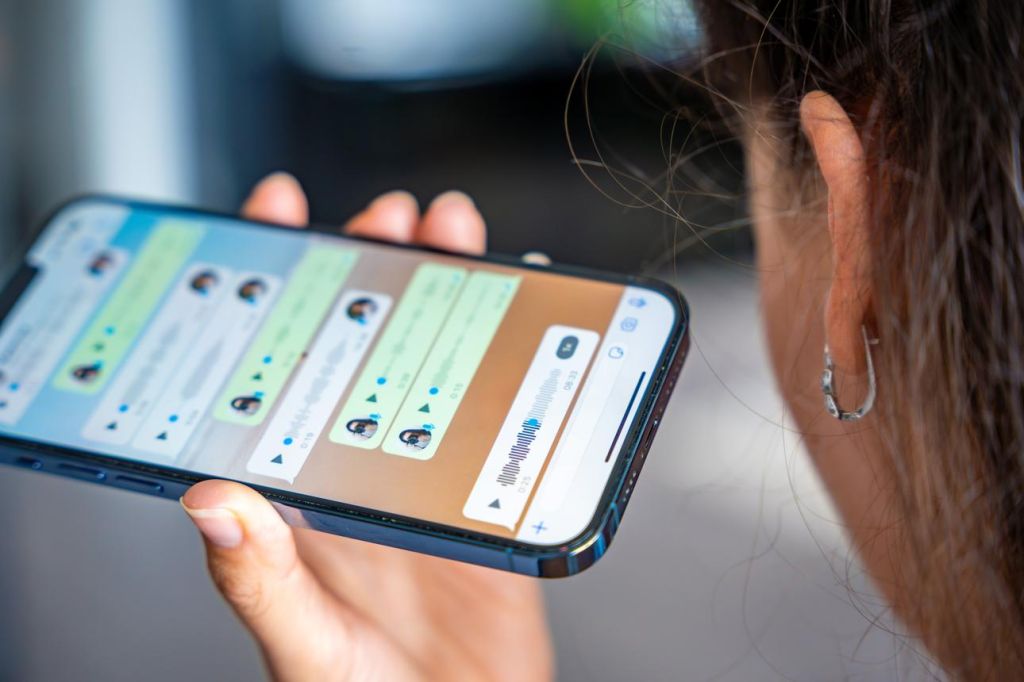
Why a three-minute voice note can feel much longer
Then there is the time required to listen to them – particularly when someone sends a string of recordings instead of one concise message.
“We read at about 200 words per minute (faster if we skim read) but people speak at 150 wpm,” explains Batho. “On top of that people are concise in text messages but tend to ramble in voice notes, so a voice note takes a lot more time.”
There is also an element of expectation involved.
“Historically, WhatsApp has been a short message app, people used email if they wished to give more detail. So, when we open WhatsApp, we expect short messages, a quick in-and-out.”
If you only have a few seconds to spare, suddenly being confronted with a lengthy voice note can therefore feel like an unexpected demand on your time.
“That’s a burden,” says Batho.
Why voice notes can create social pressure
Voice notes can also feel more personal than text messages, and that intimacy can create another layer of social obligation.
Batho explains that this can bring a feeling of deeper connection, but can also make us feel more compelled to respond in kind.
“Even if you don’t have time, it feels rude to reply with a quick text response, so we feel more compelled to take time out for a detailed voice note or response in return. That takes up mental bandwidth.”
And if you decide to reply with a voice note yourself, the cognitive load can increase further.
“We might have to find headphones, a quiet environment and in some cases, privacy. We become self-conscious because it’s personal. Thinking about what you’re saying, staying calm and coherent, remaining on track, getting it right first time… That can drain our capacity.”
But voice notes aren’t inherently bad
Of course, there are plenty of reasons why someone might choose a voice note over a written message – and not all of them are about convenience.
Batho points to neurodiversity, disability, being somewhere where typing isn’t practical, explaining something that is difficult to put into writing and situations where tone of voice or human connection is particularly important.
“As someone working with burnout, I’d recommend sending a voice note if that feels easier for you; only you get to control your outputs. People aren’t necessarily being selfish, but the needs placed on the listener are definitely greater than for a text.”
The hidden work involved in receiving a voice note
Psychologist and researcher Bob Hutchins, who studies how humans behave when using digital tools and is founder of Human Voice Media, also points to the loss of control over our attention.
“A written message is something that you can briefly scan/look at. If you need to look back on this message or you’d rather wait until you’ve got a few moments to yourself to respond, that’s fine. A three minute audio message will take three minutes to listen to. Your attention will be tied to the sender’s pace for those three minutes. This lack of control over your own attention matters far more psychologically than we often recognize.”
Hutchins also believes there is an invisible transfer of work from the person sending the message to the person receiving it.
“To record an audio message is very simple for the sender. The sender can speak aloud for many minutes without having to edit their words. Now, the receiver must locate where they want to receive this audio message. They must follow along in order to track the flow of thought. The receiver will have to recall everything that was stated. In order to get a