What would Marie Kondo say about this?
Kate Townshend is an avowed declutterer, with one exception – she keeps a hoard of treasured keepsakes, which she dips into to bring back memories sweet and sharp, and to keep her grounded. Is this the one concession to hoarding? And would Marie Kondo agree?
By  Psychologies
5 minute read
Did you know that Mary Shelley is said to have kept the heart of her dead husband, Percy Bysshe Shelley, in her desk drawer? Apparently, it was wrapped in one of his poems for added pathos. She is a heroine of mine, for her writing and politics and, while I probably draw the line at actual body parts, I have some sympathy with her attachment to this tangible reminder of her husband.
One woman’s junk…
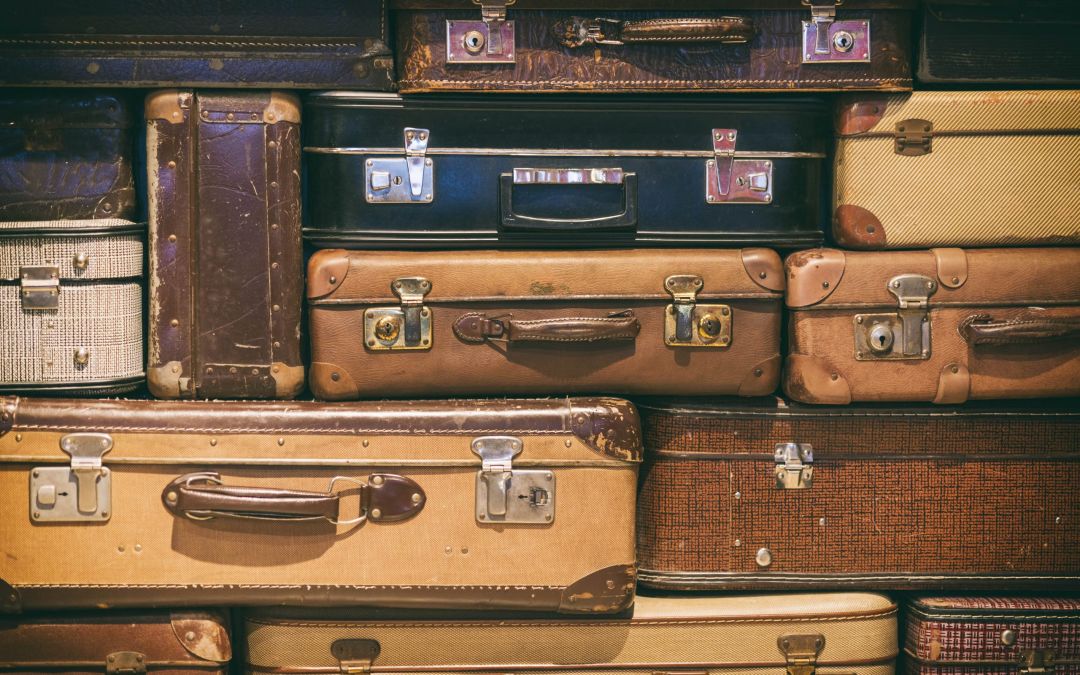
My own less rock-and-roll version of a heart in a drawer is a trunk (it used to be a suitcase, before that a cardboard box and, once upon a very long time ago, a simple paper folder) literally brimming with old birthday cards, notes passed in idle French lessons at school, love letters from exes and terrible adolescent poetry – all palpable detritus of my past.
It’s my one concession to hoarding (that and books): I am brutal when it comes to throwing out general rubbish. Clutter makes me feel claustrophobic and panicky and my husband has learned the hard way that, if he leaves an object on our kitchen table, it is likely to find its way into the bin or the recycling. But give me a crummy old receipt with a scribbled note and some kisses on it, written as he leaves the house on a random Tuesday morning, and I’ll treasure it forever.
I suppose I’ve always been this way, and maybe there’s even some sort of genetic predisposition towards this sentimental ‘treasure troving’. My mum stores every family photo ever taken in a huge chest, starting with her and my dad, impossibly young, glamorous and child-free, through to my graduation from university. There is no order to her photos and rifling through them is like entering a lucky dip of memories but, when I’m sad, or shaken, or wondering what to do next with my life, handling them is an act of calming meditation.
Protected in time
In a very real way, they bring me to an acute awareness of the fact that life is a series of moments, and that chronology isn’t everything. Even if my current situation is not a happy one, I am comforted by the knowledge that I’m surrounded by these warm memories, that they provide context for my life just as much as the present but, unlike the present, they are beyond reach in a way that makes them safe. No matter what life throws at me, these happy, snow-shaker memories persist, and there’s a profound sense of security in that.
Sometimes, I wonder if my three-year-old niece will ever know this time-travelling pleasure. There are already hundreds of photos of her online, but there’s something quite distinct about my physical photographic jumble; about reaching in and pulling out a specific moment in time. And it’s strangely satisfying to reconstruct the events around it. ‘I think it was your eighth birthday,’ Mum suggests, and we lose ourselves in a conversation about whether a particular gift came before or after I changed schools, and who gave it to me.
The way we were
I know some might say hanging onto all of this – especially in such volume – is childish. It’s the memories and relationships that matter, not imperfect physical symbols of them. And I recognise that. But, for me, the symbols add depth and richness to the memories. The smell of my school exercise book makes me a child again, in a way that simple recall could never manage. The sight of my own young handwriting; my hopes and dreams recorded with a seven-year-old’s clarity – the memory and the object are symbiotic, one feeds the other.
It’s a feeling that’s been sharpened, I suspect, since I lost my dad to Alzheimer’s. I’ve seen the visceral horror of someone cast adrift from their memories and, however silly it may sound, my flotsam and jetsam give me the sense of an insurance policy. My dad could recognise photos at a point far beyond his ability to comprehend our, ‘Do you remember…?’ anecdotes. At the end, an object that he could touch was a far more reliable witness than his misfiring brain.
Maybe there’s a reason why those with the dubious good fortune of knowing they’re dying spend time leaving tangible pieces of themselves for their loved ones to cling to when they’re gone – letters for children; lists of advice for spouses. A memory of a conversation or a day filled with joy is its own gift, but you can hold a letter. You can breathe deeply and hope to detect the faintest hint of a beloved’s perfume; you can touch the paper they touched; you can see the physical mark they left on the world; the quirks of their personality in the quirks of their handwriting. And you can reread their words with all the certainty of the first time you saw them. How could that not be precious?
This sense of developing history is another reason my memorabilia matters to me. It’s often during times of crisis that I sift through my trunk, looking for clues in my past about what I should seek in my future. It’s not all soft focus, warm and fuzzy – some objects denote memories with edges still sharp enough to cut.
My diary from my early 20s makes particularly dark reading, and I want to reach back through the years with words of hope and comfort to myself. I feel tender towards my past self, and that somehow helps me to be kinder to the me of the present. It’s too late to change the past but looking back with older, wiser eyes can provide closure.
When I was 18, I berated myself for turning down a place at a distant university because I didn’t want to be far from family, and my diary is full of self-loathing over that decision. But grown-up me sees an angsty teenager doing the best she could in a tricky situation. I try to remember that even now, when tides of uncertainty and self-doubt threaten to engulf me.
Of course, no human being can be reduced to a pile of papers and ticket stubs. But we do construct our identities, in part, from memories. When I trawl through my papers, I see myriad versions of myself, and sometimes I am reminded of aspects of who I am that might otherwise be buried: the idealism of childhood; the determination of my early 20s.
My glorious life
They’re also, quite simply, reminders of how lucky I am. Funny messages from uni friends I’m still close to; cards from Mum that bring tears to my eyes; invitations to parties I remember with a cocktail of embarrassment and fondness… The point is: there’s love and happiness in this tangle of tattered trinkets, and the balance is in favour of sweet, not bitter. No wonder I can’t bring myself to throw them out, though I’m going to need a bigger trunk.
Image: Getty