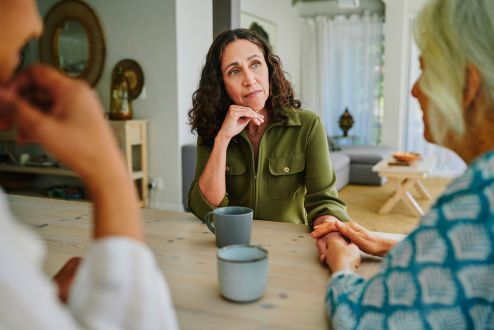
Do people always get your name wrong? A coach explains why it can sting — and how to speak up with confidence
Have you ever let someone call you the wrong name because correcting them felt awkward? Writer Greta Solomon reflects on her own experience, while an expert explains why names matter and how to speak up when yours is repeatedly mispronounced.
 Sally Saunders
Words: Greta Solomon. Images: Shutterstock
On my first day of high school, I met a girl called Urma. Except that wasn’t her name. There was a typo in every class register, so that she had to exclaim, rather persistently, that her name was actually – Urmi – and endure the raised eyebrows, and the unspoken question of, ‘Are you sure? That’s not what it says here’.
I admired her tenacity. If it was me, I’d likely have accepted it, gone home, and announced to my parents I had a new name. I mean, I’d already done a version of this in primary school. My name was pronounced Gree-ta for the first five years of my life. But when everyone at school called me Greh-ta, I kept schtum – too shy to say anything.
When my parents finally caught wind of the fact that everyone now knew me as this new iteration, they changed how they, me, and everyone else thereafter pronounced my name. The question is: why does this matter? For many people, it doesn’t.
‘Names in general tend to fall into two camps: those who are very particular about how they are said and spelt, and those who think “whatever” and choose to let it go,’ says success coach Marilyn Devonish. But despite this, what we (and others) call us affects our psyches.
‘Our names are a firm part of our identity,’ says Devonish. ‘They’re usually one of the first things we hear growing up, even if we have no conscious comprehension of what the words mean. Plus, on a practical basis, at least one person, perhaps two, or an entire collective of people have sat and thought about your name. There are millions of names to choose from, and yours was chosen for a reason because it meant something to someone. There’s a sacred process around that.’
The courage to belong
Research professor Brené Brown – who studies courage, vulnerability, shame and empathy – describes belonging as the opposite of fitting in. She says that, above all, belonging is about having the courage to stand alone and belong to yourself. This attitude is now starting to capture the zeitgeist. There’s a wave of people reverting to the full names that denote their cultural heritage.
They’re finding that they were never hard-to- swallow in the first place, and don’t need to blend in, mould, fix, or alter themselves to be more palatable. In the celebrity world, this means that the actress Thandie Newton is now Thandiwe. And the comedian Shappi Khorsandi, is now Shaparak. But if you’re still establishing yourself, this level of self-confidence can be tricky.
Devonish recalls a Nigerian friend of hers, Kayo Anosike, who after retraining for a new corporate career, failed to get any traction from her CVs and cover letters. When she changed the name on her CV to Kayla Benjamin, she landed a job within 10 days. It’s clear that what you’re called makes a difference.
An academic study of over 12,000 job applications found that more than a quarter of people with English names got positive responses for leadership roles, compared to just 11% of people with non-English names. ‘Anglicising your name will get you through the door without that level of judgement.
And if you don’t like your name, and it doesn’t bring you joy, then you could change it to something you love, that will also help you fit in,’ says Devonish. But this can come at a cost. ‘In times of slavery, for example, one of the first things taken from you, in addition to your rights and freedoms, was your name,’ she says.

Anglicising your name may unwittingly denote that your value is up for discussion. But even if you hold onto your name, others can insist on giving you an anglicised nickname – claiming that your full name is too hard to pronounce. ‘If someone, when corrected, continues to call you something other than your given name, it can feel like disrespect, or even an attack on your identity.
Similarly, it can be damaging if people can’t be bothered to learn how to pronounce your name, and continually say it wrong,’ says Devonish. If this irks you, take a pro-active stance and gently teach people how to pronounce it, by breaking it down into vowel sounds. For instance, Anosike, would be An-o-see-key.
‘If you have a Celtic name, for instance, such as Siobhan, own it, speak it confidently, and be proud of it. Give people points for trying to say it correctly, and say: “well done, that was so close!”’ says Devonish. ‘It’s also a two-way street. Always ask others how to pronounce their names. If they say that everyone calls them by a nickname, ask if that’s how they want you to address them.’
Owning who you are
If you adopt a new surname after marriage, it could alter the relationship you have with yourself, and your partner – for better, or for worse.
‘Changing to a married name can have a unifying effect on some people, but for other people it can cause a split in their personality. When they change their name, their personality no longer fits,’ says Devonish. Always remember that names have inherent power.
‘We are linguistic beings, what we say and how we say it matters. If someone has been verbally abused, they can tell you every word that was said to them. It’s an assault to the psyche, and what’s said can never be unsaid, or unheard. But when you have a sense of who you are, and your character, you know if something is fundamentally not true to you as a human being,’ she says.
You get to decide the names that are true for you. What’s interesting is that for most of my life, no-one questioned the new pronunciation of my name, but in the last 18 months, people have repeatedly asked if my name is pronounced Gree-ta. I’m certain that this is telling me something – I just have to figure out what.
The power of choosing your own name
Born Elizabeth Hazell, Beth Wild happily took her husband’s surname, Mercer, when she got married. After divorcing in 2014, she kept her new surname for the sake of her two daughters. But once they’d reached their teenage years, she realised it no longer felt right. ‘For a brief period, I changed my name back to Beth Hazell on Facebook, but it didn’t feel like me anymore.
It felt like a retrogressive step,’ says the 50-year-old from Linfield in West Sussex, who works as a documentary and portrait photographer. ‘My parents provided a loving and stable upbringing, but they didn’t empower me to be bold, or to take risks. I felt I had progressed, grown, and changed.’
‘I have a love of India, and yoga, and kirtan – a form of musical meditation based on ancient chants – so I started looking at Sanskrit names, but they felt too contrived. Then the name Wild just landed. And it’s not even as though I’m excessively wild, although I do have a love of nature. It just felt right, and it sounds good. Everything about it just works,’ she says.
At first, she hesitated, wondering what people would think, and whether it would affect her business, which was operating under the name Beth Mercer Photography. But when she announced it on social media, she received overwhelming support and recognition for her new name. And she officially changed it by deed poll in 2022.
Beth was runner-up in the 2024 National Geographic Traveller photography competition in the portfolio category, which marked her stepping into a long-held dream of being a documentary photographer.
‘I couldn’t imagine winning that competition as Beth Mercer; Beth Wild is who I am. I’ve been through an immense journey over the last few years of coming into alignment with who I am. I feel a sense of sovereignty and independence – I’m no longer defined by anyone else.’
What if your name doesn’t fit with who you are?
‘If you have a middle name, you could choose that, or use a variation of your first name. If you were called Marilyn, like me, you could call yourself Maz, or Mary, or Lynn. You could even use your surname as a first name. Find an element of your name that you love, or if your whole name is a problem, you can change it altogether,’ says Devonish. A name change can have surprising results, changing both how you present yourself, and how you’re received.
Expert Advice
Marilyn Devonish is a NeuroSuccess™ coach, a certified trainer of neuro-linguistic programming (NLP), and the founder of Trance Formations™, a training, consultancy and coaching company. marilyndevonish.com