Is your fear of getting things wrong stopping them from going right?
Anticipating failure or events not going to plan can stifle your enjoyment of life. Writer Kate Townshend explains why embracing 'wrong' can end up being right.
By 
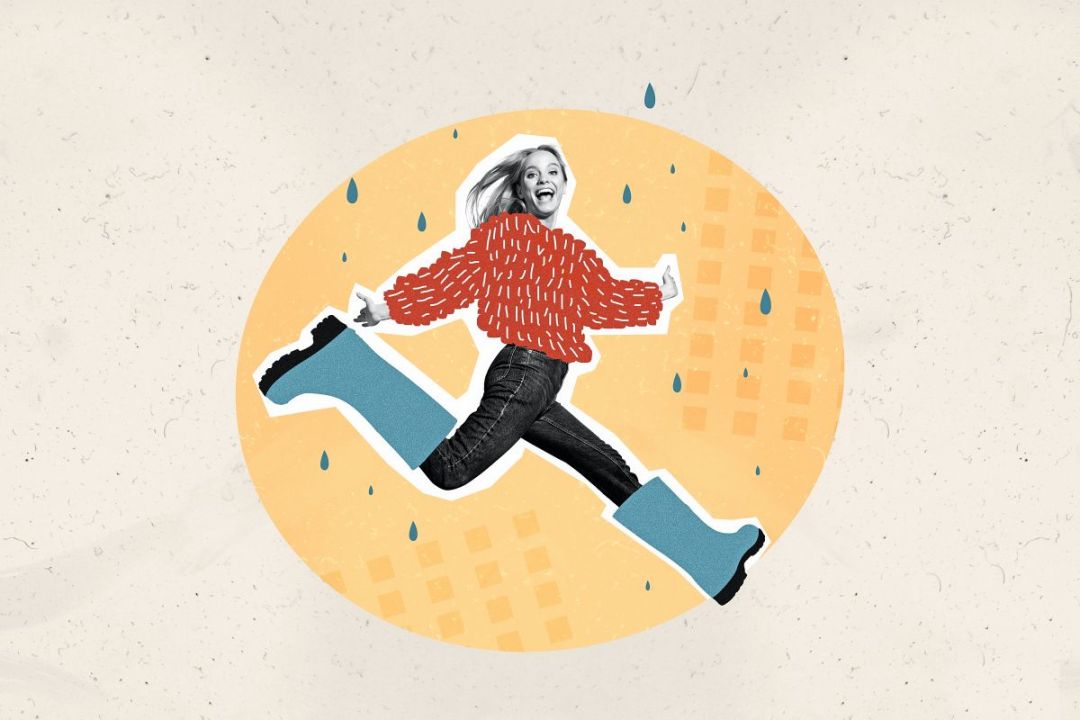
What if being wrong isn’t something to fear, but something to embrace? From fretting over rainy holidays to avoiding risks and mistakes, Kate Townshend discovers that letting go of the need to be right can be surprisingly liberating.
I adore the British countryside in the summer, so I take most of my holidays without needing to worry about flights or passports or any of those complications. The only complication I tend to concern myself with is the weather forecast – and my fear if will be ‘wrong’.
It’s been scorching recently but in the past, I’ve convinced myself that wet weather can ruin a precious week of holiday. I’ve allowed my mood to match the predicted days of dark clouds and torrential rain, depriving myself of the anticipatory joy of a break in favour of obsessively refreshing my weather apps.
But the thing about the weather is, you never can tell, even with the entirety of meteorological science at your fingertips. Sometimes, the forecast has been plain wrong. Sunny days on the beach, defying the predicted gloom.
More than this, I’ve found that often my assumptions about how much the weather will impact our fun, even if it is bad, are also plain wrong. The Cornish sea in a tumult is one of the most romantic and thrilling things I’ve ever seen.
Windswept walks and warming cups of tea in cosy cafes are an underrated pleasure. And as a year-round cold-water swimmer, a rainy holiday means I get the beach and the sea to myself in glorious isolation.
Why accepting wrong is good for you
It’s a somewhat frivolous example of something I’m slowly coming to accept: that embracing the idea of being wrong – instead of fearing it – can actually be a massive boon to my mental health.
I have a long history of imagining awful outcomes (far worse than some depressing holiday weather) in lurid Technicolor, convincing myself that they are accurate future predictions.
But when this cloud of panic descends, accepting that I may be wrong, and indeed that I have been wrong in the past, is an active comfort. When I remember that I am all too fallible, and that my feelings aren’t facts, the terror often recedes.
It’s strange, because as a naturally cautious, risk-averse person, I’ve always felt pretty negative about the idea of getting things wrong. ‘Better safe than sorry’ and ‘look before you leap’ are my go-to mottos.
But lately, I’ve started to wonder if I’m getting it all wrong when it comes to, well, getting it all wrong. Maybe there is something that wrongness might be able to teach me?

How biology makes you fear things going wrong
Psychotherapist Tina Chummun, a person-centred trauma specialist, explains that I shouldn’t judge myself too harshly when it comes to my fear of making mistakes.
“From a neurobiological perspective, being wrong activates the same threat detection systems as physical danger,” she explains. “For individuals with trauma histories or perfectionist conditioning, making mistakes can trigger genuine fight, flight, freeze or fawn responses.”
In other words, we are often battling our own biology when it comes to accepting the possibility of things going wrong. And not just our own biology, but a sort of generational bias towards a fear of mistakes as well.
“Parents can unconsciously create environments where children learn that being wrong equals being unsafe, unloved or inadequate,” says Chummun. “Breaking this cycle requires understanding that perfectionism isn’t about high standards, it’s about terror management.”
Staying firmly in our comfort zone
Of course, none of this means it’s not worth pushing through to the other side. After all, we are also quick to tell children that getting things wrong is an essential part of the learning process — so on some level we do accept that there is value in being mistaken.
“When we’re afraid of getting things wrong, we hold ourselves back and stay in our comfort zone,” says Hannah Blackburn, a somatic coach for the female nervous system. “We often aren’t completely satisfied here, but we remain stuck due to the fear of what might happen if we do fail.”
This resonates with me, as I suspect that sometimes my fear of failure has distanced me from new experiences. I am, for instance, pretty terrified of public speaking and I often find myself staying silent out of worry, when I’m actually bursting to make a contribution.
Luckily, Blackburn also explains that it’s never too late to make a change. “I like to reframe failure as a stepping stone that gets me closer to what it is I desire to achieve.
“It’s also important to take the personalisation out of it — lots of people create meaning about what it means to be successful in relation to their self-worth.
“When we go for what we want, it builds self-trust and confidence because we’re being true to who we are, and we’re doing what we say we want to do.”
Why it’s better than to try and fail
Perhaps this means that speaking up — even if my words get muddled or I turn crimson as I speak — is a form of success and achievement in itself. Things going wrong don’t render the action itself without worth.
It’s logic I can’t argue with, and if I’m really honest with myself, I could do with a bit more of this bravery in my life. There is value in being wrong and finding that we can survive it, that it isn’t the world-ending scenario we might imagine.
I’ve had literal sleepless nights about the consequences of mistakes, but I need to remember that the reality almost never matches my fears. And sometimes, as with my warm-weather worries, being wrong can be an actively positive thing.

For instance, for years, I agonised about the decision to have children, terrified that my own introversion and mental health challenges would make me an unhappy and underwhelming mother. But actually, having my little boy has been the most joyful and enriching time of my life.
“Sometimes being wrong about our limitations is the most liberating experience possible,” says Chummun. “I’ve watched clients discover they were wrong about being ‘too damaged’ for love, ‘too old’ to change careers, or ‘too broken’ to heal. That kind of wrongness transforms lives.”
How to tolerate discomfort
I’m starting to think that there might be a moral component when it comes to willingness to get things wrong. Being wrong — or at least risking it — is often morally courageous, as it involves action rather than safe passivity.
Though, as Chummun points out, it’s important to remember we’re not all starting from the same context here.
“For individuals from marginalised backgrounds, being wrong can feel exponentially more dangerous because it may confirm negative stereotypes or jeopardise hard-won opportunities. This adds complex layers to risk-taking and mistake-making that privileged individuals rarely consider.”
For me, though the idea that I might speak up and be mortifyingly mistaken is frightening, the alternative means never taking a stand at all. “It requires courage and the willingness to learn from mistakes,” says Blackburn, “which is hugely character building in itself.”
And even if I do find myself on the wrong side of things, there’s an opportunity for correction and growth that simply isn’t possible without the initial misstep.
It seems that, once again, there can be a real connection between wrongness and authenticity. And it’s worth risking the one to achieve the other.
“The goal isn’t to be wrong more often, but to develop what I call ‘wrongness tolerance’,” explains Chummun. “For many people, learning to be wrong safely requires healing old wounds about acceptance, belonging and worthiness.”
Perhaps, if being wrong can actually be brave, useful and true, I can start to consciously risk it a little more. After all,
if the weather forecasters get things wrong from time to time, so can I.
Words: Kate Townshend, Images: Shutterstock