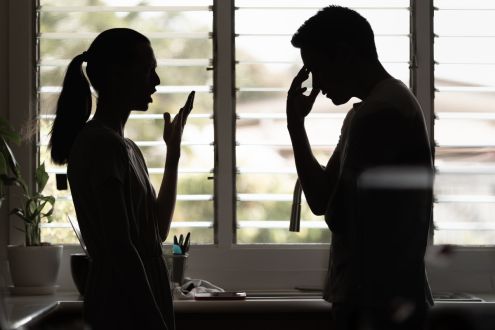
Loving a narcissist: why do you have to become invisible just to make them feel special?
When one partner needs constant admiration and reassurance, the other can end up suppressing their own needs just to keep the relationship on an even keel.
 Sally Saunders

There’s a particular kind of loneliness that comes from being in a relationship where everything seems to revolve around the other person. Their feelings take priority, their achievements deserve recognition, their disappointments require attention. Meanwhile, your own needs become increasingly difficult to express.
It isn’t necessarily that your partner doesn’t love you. It’s just that their need to feel admired, important and emotionally reassured can leave surprisingly little room for you.
Dr Jemma Anderson, a chartered educational psychologist, says: “Relationships are important contexts in which we learn about ourselves. In healthy relationships, there is room for both people to have needs, express difficult feelings, distress and influence what happens between them. Each person can be recognised as someone with their own perspective, rather than being valued only for the reassurance or admiration they provide.”
When they see your independence as rejection
Cheryl Kennedy MacDonald, registered psychotherapist and founder of Female Focused Therapy, specialises in helping victims of narcissistic abuse. She explains how intimacy can become entangled with one person’s need to maintain their self-worth.
“The relationship can become a means of maintaining their self-worth, meaning less mutual intimacy. Their partner’s independence may feel like rejection, or a boundary feels like an insult. In a pattern of overgiving, generosity can become a debt: ‘After everything I’ve done for you.’ The other person may start neglecting their own needs to avoid that reaction.
“Understanding someone’s vulnerability doesn’t make the imbalance harmless. Their partner still needs to feel safe emotionally.”
When your hurt becomes their defence
One of the most exhausting aspects of narcissistic relationship dynamics is trying to explain why you’re hurt, only to find yourself managing your partner’s reaction instead.
Therapist and confidence coach Ludovica Colella says: “The relationship can gradually become organised around protecting one person’s self-esteem rather than meeting the emotional needs of both partners. In some narcissistic relationship dynamics, the other person becomes responsible for providing reassurance and emotional stability. Their needs may be welcomed when they reinforce the narcissistic partner’s self-image, but experienced as threatening when they need accountability or compromise.
“One of the more complicated aspects is empathy. Some people with strong narcissistic traits can intellectually understand that their behaviour has caused pain, but struggle to remain emotionally connected to that pain when acknowledging it would threaten their own self-image. Rather than allowing guilt to lead to reflection and repair, the shame may trigger defensiveness.
“This can create a painful cycle in which one partner repeatedly explains why they’re hurt, while the other focuses on defending themselves against the accusation. Over time, the partner may begin censoring their feelings or avoiding difficult conversations simply to maintain peace. The relationship becomes emotionally unequal and one person’s self-esteem is continuously protected, while the other’s emotional reality becomes increasingly invisible.”

The things you stop doing to keep the peace
Sometimes control isn’t about what you’re explicitly told to do. It’s about the adjustments you gradually make to avoid upsetting someone.
Dr Lisa Turner, founder of CETfreedom and creator of ValidateAI, approaches this through control theory, the engineering of how systems regulate themselves.
“In a healthy relationship, both people influence each other while retaining their autonomy. But when one person’s emotional needs consistently take precedence, they can become the controlling agent, with the other’s behaviour increasingly organised around keeping them satisfied.
“The partner learns which subjects to avoid, which achievements to downplay, which needs to suppress. Each adjustment seems reasonable, but cumulatively their freedom shrinks. Nobody necessarily issued an order.
“This is why I created Validate, an AI tool that examines relationship communications for patterns of manipulation and coercive control. Sometimes we need help seeing the pattern because we’re too close to the individual incidents.
“Control isn’t always visible in what one person demands. Sometimes it’s visible in what the other person no longer dares to do.”
When accommodating someone else means losing yourself
Dr Anderson also highlights how these patterns can affect our expectations of closeness and what we believe love requires of us.
“From a developmental perspective, relationships can reinforce existing expectations about closeness. If one person repeatedly learns that connection depends on accommodating the others emotional needs, they may become increasingly cautious about expressing themselves.”
It’s worth remembering that wanting admiration, reassurance or attention isn’t inherently narcissistic. All relationships involve compromise, and there will be times when one person’s needs take precedence. The difference is whether you both have the freedom to be heard, respected and supported.
Can you disagree without them punishing you emotionally? Or express hurt without having to defend it? Can you celebrate your own achievements without worrying about how your partner will react?
If the answer is consistently no, it may be time to look more closely at the relationship.