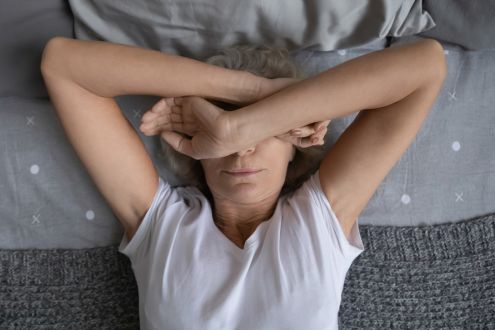
Yes, you can’t sleep. No, it might not be insomnia. Five possible reasons you’re not sleeping well
If you're struggling with sleep, don't automatically assume insomnia is the answer. Sleep expert Heather Darwall-Smith explains what else could be going on
 Sally Saunders
If you’re lying awake at night, waking repeatedly or feeling exhausted during the day, it’s easy to conclude that you have insomnia.
But according to sleep expert and psychotherapist Heather Darwall-Smith, that’s not necessarily the right diagnosis. “There are over 80 different sleep disorders,” she says. “So it’s very often not insomnia.”
That matters because if something else is behind your sleep problems, repeatedly trying to improve your bedtime routine may not solve the real problem. Darwall-Smith is particularly interested in asking a question that is surprisingly easy to overlook: What else could it be? Here are five possibilities.
You may have sleep apnoea
Sleep apnoea is a condition in which breathing repeatedly stops and starts during sleep. Those interruptions can seriously fragment your sleep, even if you don’t remember waking up.
Darwall-Smith describes sleep apnoea as “massively under diagnosed” and says some people may assume they have insomnia when something quite different is happening.
You might spend hours trying to work out why you can’t sleep, when the bigger issue is that your sleep is repeatedly being disrupted once you are asleep.
Loud snoring, waking with a dry mouth or headache, excessive daytime sleepiness, or a partner noticing pauses in your breathing can all be reasons to discuss sleep apnoea with a healthcare professional.
Your legs may be disrupting your sleep
Another possibility Darwall-Smith highlights is periodic limb movement disorder, in which involuntary movements of the limbs occur during sleep, and you may have no idea that it’s happening. Instead, you might simply wake feeling as though your sleep has been broken or strangely unrefreshing.
That’s one reason unexplained poor sleep can be so frustrating: you experience the symptom, but not necessarily the thing causing it.
If you’re repeatedly waking or feeling exhausted without understanding why, it’s worth considering whether something physical could be disrupting your sleep.
You may be sleeping too much, rather than too little
We tend to think of sleep problems as meaning one thing: not getting enough. But excessive sleepiness can be a problem in its own right.
Darwall-Smith works with people experiencing hypersomnia, where someone may sleep for long periods yet still experience significant sleepiness.
Instead of lying awake desperate to sleep, you may be spending a great deal of time asleep and still struggling to feel properly awake during the day.
The important question isn’t simply how many hours you’re getting. It’s whether your sleep and wakefulness are functioning normally for you.

Your working life may be the problem
For some people, the difficulty is not an individual failure to sleep but the demands of their schedule. Shift workers are effectively being asked to sleep and wake at times that can change from day to day.
Darwall-Smith is particularly interested in the psychological impact of this kind of disrupted sleep, including among healthcare workers.
And then there are people she describes as “shift workers by default”: new parents. “New mums who are trying to look after their baby all night — they are shift workers by default,” she says.
When you’re waking repeatedly to care for a baby, conventional advice about creating the perfect uninterrupted night’s sleep can feel completely disconnected from reality.
You may have one of dozens of other issues — which need a proper sleep assessment
Perhaps the biggest mistake is assuming that everyone who says “I can’t sleep” has the same problem.
Darwall-Smith points out that the symptoms of very different sleep disorders can overlap. One person may have insomnia. Another may have sleep apnoea. Another may have a movement disorder. Someone else may be excessively sleepy rather than unable to sleep.
“The symptom sounds similar,” she says. “The underlying problem isn’t.”
That is why persistent sleep problems deserve more than endless experimentation with sleep tips. If you’re struggling for weeks or months, or your sleep is significantly affecting your daytime life, talking to a healthcare professional can help establish what’s actually happening.
Stop trying to fix the wrong problem
There is something reassuring about Darwall-Smith’s approach: not every sleep problem requires you to become better at sleeping.
Sometimes you need to find out why sleep isn’t working properly in the first place. “It’s really hard to get diagnosis right,” Darwall-Smith says.
That is precisely why the question What else could it be? can be so useful.
Images: Shutterstock