
The secret language between you and your dog: how they may know when you are feeling unwell
Dogs may not understand that you’re ill, but their powerful senses can pick up changes in your smell, body language, voice and routine. Experts explain what your dog could be noticing - and why their reaction doesn’t necessarily mean they know you’re sick
By 
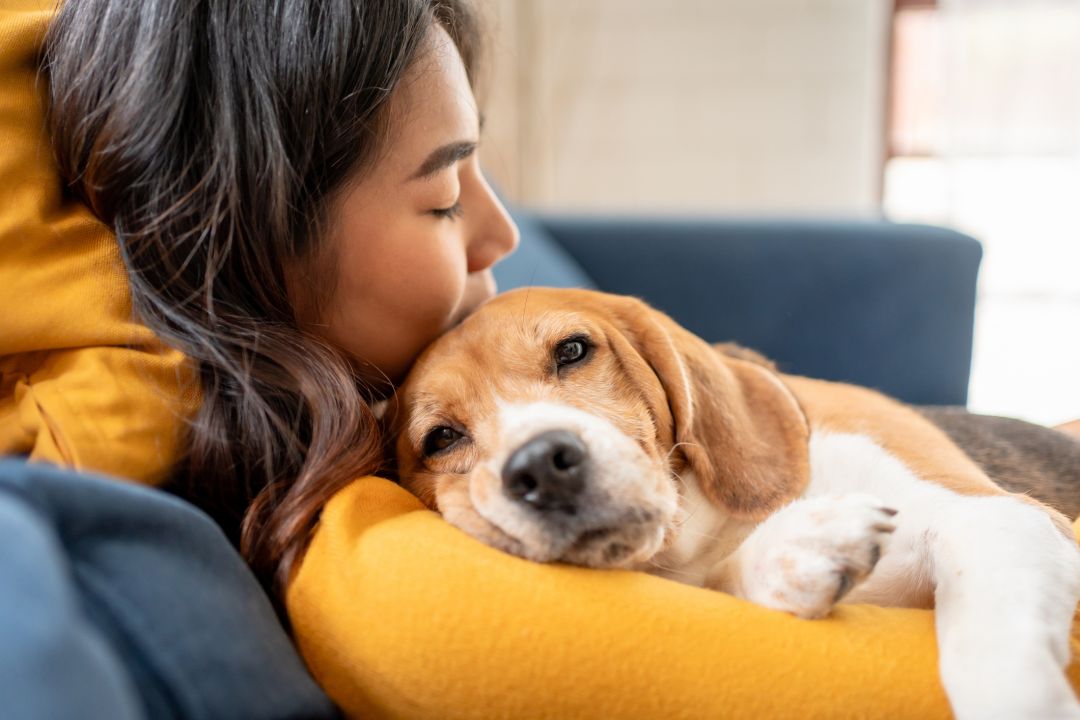
Many dog owners have claimed that their furry friend seems to sense when they are poorly and whilst there’s no scientific evidence to back this up, it’s a fairly common belief. As an owner of two, I have seen how my dogs have been extra attentive to me on the odd occasion I have been unwell so I am one of those who agree with this thought process. To understand why this is, I asked two dog behaviour specialists to explain just how our pets may notice when we are under the weather.
What does the research say?
Although there is no concrete evidence that says dogs can detect an illness, various research studies have proven that the behaviour of dogs and owners can influence one another. The most recent one conducted in 2024, which involved a Finish study looking at dogs’ and owners’ heart-rate variability, found that it was significantly correlated overall. Although the researchers called this “co-modulation” rather than claiming that the dogs and owners hearts literally beat in lockstep, it is a clear indication that suggests the physiology and behaviour of both can influence one another.
This is one study that Chris Loverseed, owner and head dog trainer at Positive K9 Training points to as reference.
“This published study looking at owners and dogs together which found a relationship in their heart-rate variability, particularly while resting, is a good indicator that there is a connection. It’s not saying their hearts beat at exactly the same time, or that this tells the dog you’re ill, but it shows there is some kind of emotional relationship,” he pointed out.
“However, although there are some dogs that genuinely don’t seem to care, with my own experience I’ve seen some are a lot more in tune with my emotions. Whether you want to call that empathy or something else, the difference between individual dogs can be quite noticeable.
“Dogs can certainly notice changes in people, but I wouldn’t put a percentage on how many recognise that their owner is ill. Those are two different things. Also, a dog that doesn’t come over and comfort you hasn’t necessarily missed the change, it doesn’t mean the dog has less of a bond with you.”

What signs can a dog detect when their owner is feeling poorly?
For dogs that do show signs of noticing their owner is feeling poorly, Chris Loverseed says there are a few factors that come into play.
“Body language, your voice, what you’re doing differently, and then smell as well. If you’re normally quite active and now you’re lying on the couch all day, obviously that is a change. You might be moving differently or talking differently. Dogs can get emotional information from our faces and voices, and that’s been shown in research too.
“With smell, you can take the person’s body language out of it altogether. The Queen’s University Belfast researchers tested that in 2022 with four trained dogs. Breath and sweat from before a stressful task, and then afterwards. The dogs could tell the samples apart.
“If you lie on the couch and the dog comes over and gets a cuddle that can be rewarding for them as well. It might be part of why they come over next time. You’re not necessarily going to be able to separate all of that out just by watching them.”
What about emotional contagion?
“There is also quite a bit of research on dog-human emotional contagion,” he adds. “Essentially, how you’re feeling can affect how the dog feels. It doesn’t mean the dog understands why you’re upset. You can get a dog becoming unsettled around an upset owner, for example, rather than coming over and being comforting. That’s why I’d look at what the dog is actually doing. Can it come over and then settle, or is it following you around, panting and unable to relax? Just being close to you doesn’t answer that.”
There’s been many cases of owners reporting that their dog has detected an illness, something Chris puts down to their sense of smell. He refers as an example to a Parkinson’s study in 2025 where the researchers used two trained dogs and skin swabs.
“The dogs could tell the Parkinson’s samples apart from the controls, but they did make mistakes as well. Prostate-cancer work has used urine samples. So, depending on what you’re looking for, you can be working with different material. The reason this is possible is that some illnesses change the chemicals our bodies give off. There can be a change in smell for the dog to learn.
“You’re teaching the dog, this is the smell I want, and this is how I want you to tell me you’ve found it. You reward that response. But can it leave the samples without that smell alone? For me, that’s an important part of the training as well. You then need to test it with samples it hasn’t learnt on, and the handler can’t know where the target is. Dogs pick up on what we’re doing, so you don’t want the person helping them find it.
“With your own dog, obviously you haven’t done all of that. It might notice something different about you, but you don’t know what it’s responding to. I wouldn’t use a pet’s reaction, or lack of one, to tell someone whether they’re ill.”
What breed of dogs are best known to detect illness?
As for how attuned dogs can be, when it comes to what breed is more aware of our feelings than others, it can vary.
According to Mikayla Morris, Canine Behavior Expert Council at Dogtopia, the most consistent way to gather this information is to look at what breeds we typically use for medical alert service dogs.
“Although a sniffer is a great tool for medical alert dogs, it is not the only thing they are using to tell if their human is struggling,” she explained. “Medical alert dogs are also paying attention to body language and behavior. The most common breeds used for medical alert dogs are Labrador Retrievers, Golden Retrievers, Lab/Golden crosses, and Standard Poodles.
“Assistance Dogs International notes that Labs and Goldens are especially common because they tend to combine people-orientation, confidence, trainability, and manageable activity levels. Of course, other dogs can do well in this field with training but these breeds are tried and true for their mix of handler focus, scenting ability, and stable temperaments.” From my own experience, as an owner of a ten-year-old cockapoo and three-year-old golden doodle, they both are great at sensing when I or my kids are not well. That could partly however be down to the fact they are “velcro” dogs that follow me around everywhere so are super aware of every movement I make!
And this is something Mikayla touches on: “As dog owners, our pups can become in tune to our behavior and routine quickly. When we spend a lot of time with our dogs, they have a large amount of information about what their person’s “normal” looks, sounds, smells, and feels like. This makes it easy for them to notice something changes from the baseline behaviors. If your pup does notice changes, they may respond by becoming extra cuddly, following you around more, being extra sniffy, staring at you, or sometimes even keeping their distance. Unfortunately, there is not any research to support something like “90% of the time a dog can identify when their owners are sick.”
“In the case of stress for example, your pup may detect changes like altered breathing, changes in heart rate, body posture, facial expression, movement, tone, and even a change in body odor,” she adds.
“Physical illness can be a bit more complicated since different physical conditions can produce different chemical changes. Although your pup may be able to detect something is different, that is not them being able to interpret what exactly is going on.”