Could ‘emotional blindness’ be making life harder than it needs to be? Here’s how to recognise the hidden clues
 Amy Mica Marsden
If you never know what you feel, life can be more complex and frustrating than it needs to be. We asked an expert all about alexithymia (or ‘emotional blindness’) and how to navigate it.
Words: Amy Mica Marsden. Images: Shutterstock.
It often goes unnoticed, and in fact many people don’t even realise they have it. Still, it’s thought that up to 10% of the global population has a condition called alexithymia (also known as ‘emotional blindness’).
Picture this: your favourite ornament in your house falls off the shelf and smashes, completely irreparably. How do you feel about it? Sad? What about if it was someone else’s fault, or you’d been meaning to move it for a while and hadn’t gotten around to it? How do you feel now?
If you answered ‘I don’t know’ once the feelings got a little more complex, there’s a chance you might have alexithymia, or difficulty identifying, naming, or communicating feelings and emotions.
‘When asked, “How are you feeling,” your initial response is, “I don’t know,”’ explains EMDR certified therapist Ivy Ellis, LCSW. ‘Your internal cues alone may not provide enough information; you often need to sit and analyze additional evidence to determine how you feel.’

How likely am I to have alexithymia?
‘Some people are born with alexithymia, while others develop it later in life,’ says Ivy. ‘A large portion of autistic adults are also alexithymic, and certain mood disorders, such as depression, are linked with the condition.
‘For those who develop alexithymia later in life, it may be an adaptive response to trauma or difficult experiences, so it doesn’t feel safe to feel.’
It’s thought that between 50 and 80% of people with Autism Spectrum Disorder have alexithymic traits, so if you suspect you might be neurodivergent, it’s worth looking into.
How can I learn to recognise my emotions?
The good news is that you can learn to recognise your emotions better with time and the right tools, even with alexithymia.
For example, it can be helpful to try and name the emotion if you can. Ivy recommends using a ‘Feelings wheel’ (below) as one helpful step in recognising and describing feelings.
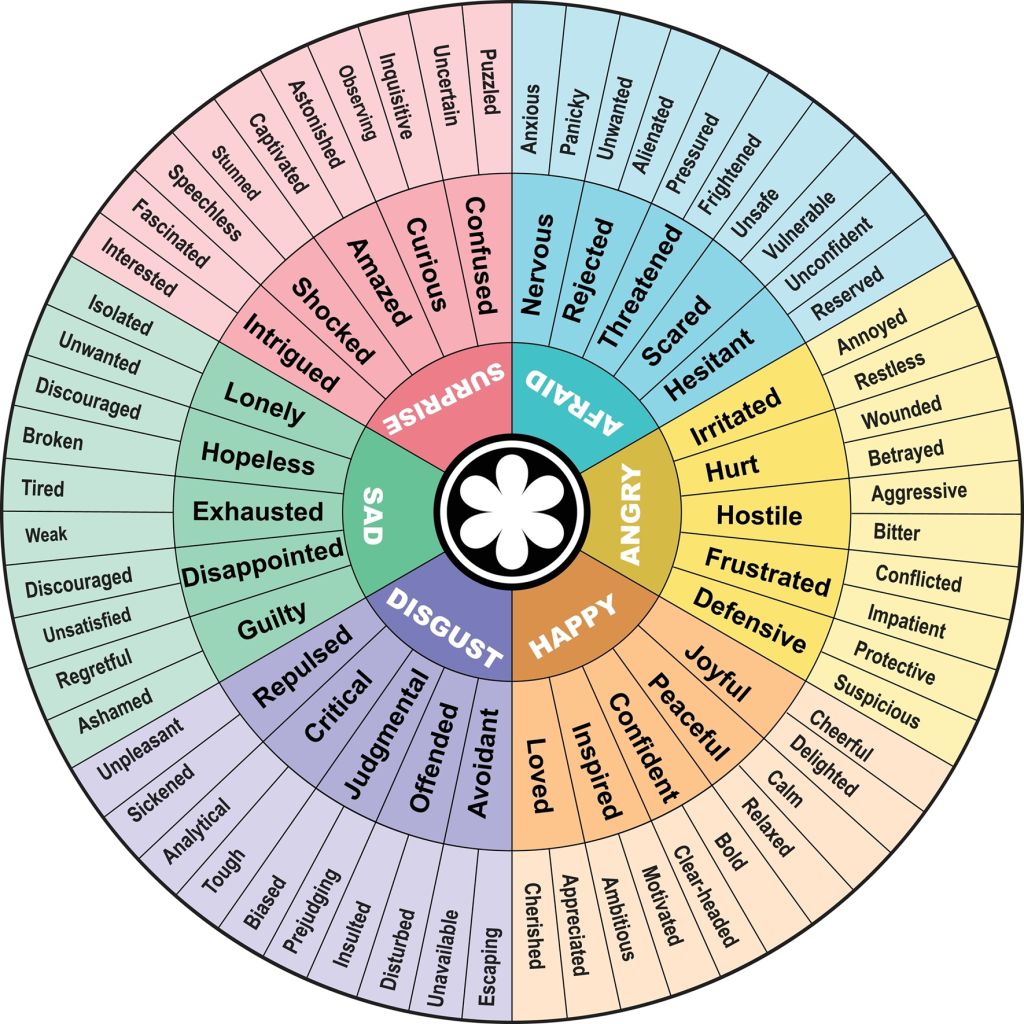
When you’re experiencing a feeling, select the basic emotion from the centre of the circle, and think about the more nuanced feelings attached to it in the second row, and so on. If you’re not sure of the core emotion, you can work backwards from a word in the outer ring. This can help you build your emotional vocabulary.
Ivy also recommends checking in with any physical sensations you’re experiencing, and using them as clues to help you identify your feelings.
‘Your internal cues are likely very subtle,’ says Ivy. ‘Notice small shifts. For example, if your stomach starts to ache, you may be feeling nervous. You may also recognize a feeling because of your actions. For instance, “I yelled at my partner, so I must be frustrated.”’
Other common physical sensations and what they could mean:
- – Racing heartbeat, shaking, shortness of breath, nausea – anxiety or fear
- – A flushed or warm face, watering eyes, inability to make eye contact – embarrassment
- – Tension in your shoulders, clenched jaw, shallow breathing – stress or worry
- – A lump in your throat, heaviness in your chest or stomach, fatigue – sadness or grief
- – Warm sensation in the stomach or chest, ‘butterflies’ or tingling in the stomach – happiness or love
For more information on physical sensations/indications of emotions, The Emotion Thesaurus can be a useful book.
How can my loved ones help me?
If you struggle to identify your emotions, you can ask loved ones to help you understand. This could be by asking them how they would feel in your situation, or by getting them to help you with the feelings wheel.
If you’re looking for ways to help a loved one with alexithymia yourself, Ivy says: ‘Recognize that the way they identify and express feelings may not look typical.
‘Just because it’s different doesn’t mean that they don’t experience feelings. It’s best not to place expectations on them. Give them space to communicate their feelings in other ways, such as sharing a metaphor.’
And remember, there’s a difference between alexithymia and a lack of empathy or emotion.
‘Even if someone has alexithymia… They can still read and respond to others’ emotions and are often quite intuitive about how others are feeling.’