Are we making our relationship with food more complicated than it needs to be?
 Sally Saunders
From childhood messages about finishing your vegetables to the language of “good” and “bad” foods, the way we learn to think about eating can shape our relationship with food for years.
Our relationship with food doesn’t begin with diets, calorie counting or concerns about weight. It starts much earlier.
As babies, says nutritionist Laura Thomas, we have a fairly straightforward relationship with eating. “My baby isn’t in his high chair worrying about the calories in a banana. He’s kicking his legs with joy. When he’s finished a meal, he throws the rest on the floor. He knows when he’s full.”
But that simplicity can become complicated as we grow up.
Messages about food can begin early: you can’t go out to play until you’ve eaten your broccoli; if you pass your test, you’ll get a sweet. Food becomes associated with reward, punishment, approval and achievement.
Over time, those associations can contribute to a more complicated relationship with eating.
“We need to get rid of the guilt, shame, and judgment we have acquired around food and our bodies,” says Thomas.
She makes an important point about the idea of emotional eating itself.
“We cannot unlink emotions from food. All eating is emotional eating. If you think about it, we are humans. We have emotions, and we have to eat. Neither can we turn off our emotions whilst we eat.”
That doesn’t mean every eating habit is problematic. Rather, it challenges the idea that there is a perfectly “emotional” way to eat and a perfectly rational one.
When food becomes good or bad
One of the most persistent messages we absorb is that some foods are “good” while others are “bad”.
Thomas believes we would benefit from moving away from this moral language.
“Although different foods have different nutritional values, we should start viewing everything as neutral rather than morally good or bad.”
Even the words we use can influence how we feel about eating.
“Using terms such as junk food is setting ourselves up for a loaded experience,” says Thomas. “It highlights the message that if you eat it, then you are an unworthy person.”
Her conclusion is deliberately simple:
“It’s ludicrous. It’s just food.”
That doesn’t mean nutritional differences don’t exist. It means that what we eat doesn’t need to become a judgement about who we are.
Are you actually hungry?
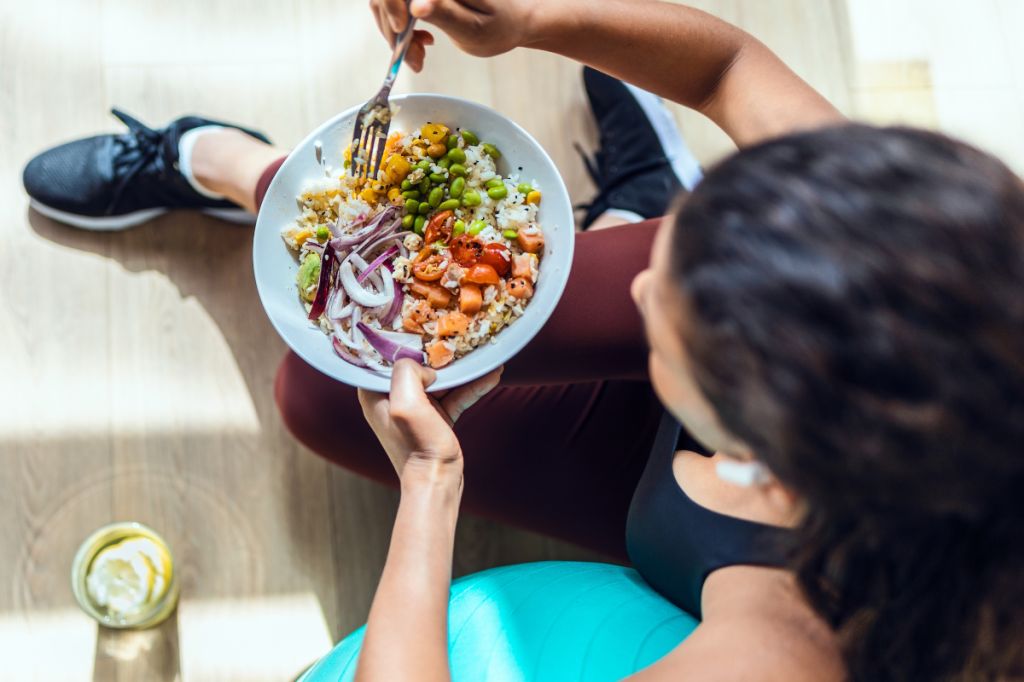
There is another reason it’s worth questioning the language around comfort eating: sometimes what we label as emotional eating is simply hunger. Thomas says that people seeking help with “comfort eating, or stress eating, or whatever they want to call it” will often describe their daily food intake.
They may skip breakfast because they’re in a rush, eat a salad for lunch because they’re “being good”, and go to the gym after work.
Then they get home and “they’re raiding the fridge and eating everything in sight”.
It can look like a failure of control.
But, says Thomas, “what they are describing isn’t emotional eating; it’s hunger.”
Restricting food during the day can leave you extremely hungry by evening. If you’ve also been avoiding foods you genuinely enjoy, it’s hardly surprising that those foods become particularly appealing.
“If you restrict calories and deprive yourself of the things you really want to eat, no wonder you’re tempted to reach for sugary foods at the end of the day,” says Thomas. She compares it to a car.
“It’s the equivalent of letting the petrol tank in your car run right down until you’re running on fumes. When it gets that low, the response is to fill it back up to full.”
The point is not that hunger explains every episode of overeating. Emotional factors, habits and environment can all play a part. But before assuming that an evening eating spree is about a lack of willpower, it is worth asking whether you’ve simply spent the day trying not to eat very much.
Change the language, not just the food
For anyone trying to develop a more comfortable relationship with eating, Thomas suggests paying attention to the words used to describe food.
Are you calling yourself “good” because you ate a salad? “Bad” because you had pizza? Feeling guilty because you ate cake?
A useful starting point, she suggests, is to neutralise that language and move away from the good-bad dichotomy.
That means allowing yourself to recognise that different foods offer different things, while also accepting that satisfying and pleasurable food has a place in your diet.
It may sound like a small change, but removing the moral judgement can change the way we think about eating.
Instead of I shouldn’t have eaten that, it becomes: I ate it. Did I enjoy it? Am I satisfied? Am I hungry?
Food doesn’t have to be a test of character. Sometimes it’s just food.
Words: Lucy Rawlinson, Images: Shutterstock