The charming monster: how serial killer Ted Bundy escaped justice twice to kill again
Ted Bundy exploited his charm, intelligence, and a series of astonishing security lapses to escape from custody
By 

Ted Bundy exploited his charm, intelligence, and a series of astonishing security lapses to escape from custody twice in 1977. Here’s how…
Ted Bundy’s killing spree spanned multiple American states. Over a four year period, the notorious serial killer raped, assaulted, and murdered more than 30 women. However FBI investigators suspect his true victim count is over 100.
Bundy’s ability to manipulate the legal system and slip through the fingers of law enforcement granted him the time and space to indulge his darkest fantasies, leaving a trail of devastation before his final date with the electric chair.
The tools of a monster: A traffic stop exposes Ted Bundy’s true nature
Bundy’s luck began to run out on 16 August 1975, when a police officer pulled over his Volkswagen Beetle in a residential area. Inside the vehicle, the officer discovered a crowbar, handcuffs, a ski mask, and pantyhose with eyeholes cut out.
While initially suspected of burglary, investigators quickly linked Bundy to a kidnapping attempt from November 1974. Posing as a police officer, Bundy had tried to handcuff 18-year-old Carol DaRonch inside his car. She managed to flee, later identifying Bundy in a police line-up. On 30 June 1976, Bundy was found guilty of assault and kidnapping, receiving a sentence of one to 15 years in a Utah state prison.
While serving his time, Colorado authorities tied Bundy to the murder of 23-year-old Caryn Campbell, whose body was discovered near a ski resort. Transferred to the Garfield County Jail in Glenwood Springs, Colorado, to await trial, the former law student chose to represent himself.
A leap of blind faith: The 30-foot fall that shocked aspen
This decision proved to be a critical mistake by the court. The presiding judge granted Bundy extraordinary privileges, excusing him from wearing handcuffs or leg shackles so he could research his case in the courthouse law library.
On 7 June 1977, during a preliminary hearing, Ted Bundy saw his opportunity. As he later recounted to prison psychologist Dr Al Carlisle:
“The guard went outside for a smoke. The windows are open, and the fresh air is blowing through… I said, ‘I’m ready to go,’ and walked to the window and jumped out.”
Bundy plummeted 30 feet, spraining his ankle upon impact. Lacking a plan, money, or a backup team, he shed a layer of clothing and limped into the wilderness of nearby Aspen Mountain.
Within ten minutes, authorities realized he was gone, setting up roadblocks and placing the town on high alert. Bundy hid in a hunting cabin to steal supplies and a rifle, but he quickly became lost and disoriented in the forest.
After six days of sleep deprivation and severe ankle pain, Bundy returned to Aspen to steal a car. His erratic driving immediately drew the attention of local police, who pulled him over and took him back into custody.

Starving for freedom: How Ted Bundy shrank himself to escape jail
Stripped of his legal privileges, Ted Bundy was returned to the Garfield County Jail. However, he immediately began planning a more sophisticated breakout, correcting the lack of preparation that foiled his first attempt.
Over the next six months, Bundy amassed $500 in cash, smuggled in primarily by his future wife, Carole Ann Boone. He also acquired a jail floor plan and a hacksaw blade from fellow inmates.
Bundy targeted an unsecured ceiling grate in his cell. To squeeze through the tiny one-foot square opening, he spent months systematically starving himself, losing two and a half stone (35 pounds).
By 30 December 1977, with the prison operating on a skeleton staff for the Christmas holidays, Bundy executed his plan. He piled books onto his bed and arranged blankets to mimic a sleeping body.
He then squeezed through the ceiling grate, navigated the tight crawl spaces, and broke through the ceiling of the chief jailer’s apartment, who was out for the evening. After changing into the jailer’s civilian clothes, Bundy calmly walked out the front door.
It took 17 hours for guards to discover the dummy in his bed. By then, Bundy had stolen a car, caught a flight, boarded a bus, and arrived in Chicago—some 1,100 miles away.
The Chi Omega Massacre: A final, frenzied trail of terror
Nine days later, Ted Bundy arrived in Tallahassee, Florida. Despite being placed on the FBI’s Ten Most Wanted Fugitives list, he remained at large for a month and a half. During this period, he unleashed a final wave of violence.
On 15 January 1978, Bundy broke into the Florida State University Chi Omega sorority house. In a manic 15-minute window, executed within earshot of 30 witnesses who heard nothing, he brutally beat and strangled Margaret Bowman (21) and Lisa Levy (20). He severely assaulted two other women in the house before being startled by incoming car headlights. Later that night, he attacked another female student, leaving her permanently deaf.
On 9 February, after a failed abduction attempt in Jacksonville, Ted Bundy kidnapped 12-year-old Kimberly Leach from her school in Lake City. She would become his final victim; her body was found seven weeks later in a pig shed.
Bundy’s execution: Two thousand volts bring an end to the nightmare
Bundy’s run ended on 15 February 1978, when a police officer pulled him over in a stolen vehicle. Bundy attempted to flee on foot but was quickly tackled and subdued. Upon his arrest, a defeated Bundy muttered, “I wish you had killed me.”
Within two years, Bundy was tried and convicted for the sorority house slayings and the murder of Kimberly Leach. He was sentenced to death by electrocution.
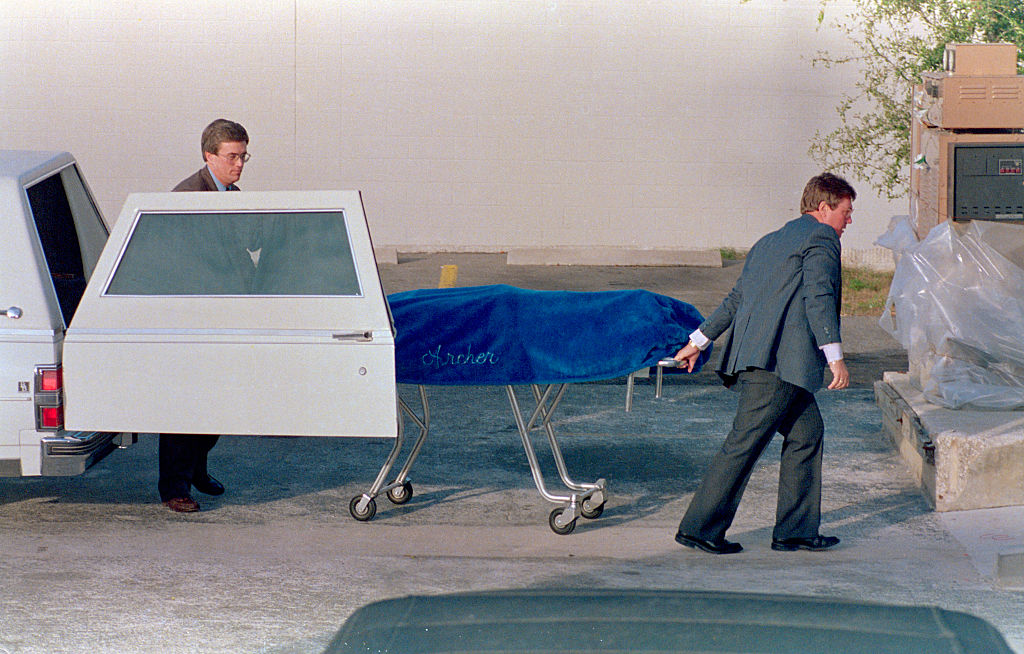
After a decade of appeals, Bundy’s time finally ran out. On 24 January 1989, at the age of 42, Theodore Bundy was executed in Florida’s electric chair. Outside the prison, a crowd of thousands cheered, banged frying pans, and chanted “Burn, Bundy, burn!” as the monster who used charm to mask his malice was pronounced dead at 7:16 a.m.