I thought my stress was all in my head — until I noticed I was holding my breath all day long
By  Psychologies
If you’ve ever been told to ‘just relax’ and found it impossible, the missing piece may not be mindset — but muscle tension, breath and the way your body is holding stress. Discover these ways to calm your body
You might think your stress lives in your thoughts. In the email you can’t quite word properly. In the conversation you keep replaying. In the low-level sense that you’re behind, again.
For years, my colleagues used to ask me the same question: “Are you okay?”
“Yes, fine,” I’d reply. “Why?” “Because you keep sighing.”
Sighing? I hadn’t even noticed I was doing it. But once they pointed it out, I couldn’t unsee it. Every so often, in the middle of the day, I would take a huge, audible breath — the kind that sounds like exasperation. The reality was that my breathing had become so shallow, so tight, that my body was periodically forcing a deeper inhale just to compensate. In effect, I was holding my breath for minutes at a time — or really, all day long. My shoulders were slightly raised. My jaw hovered half-clenched. My stomach subtly drawn in. I wasn’t consciously anxious. But my body clearly thought I was under threat.

Why “just relax” doesn’t calm your body
We experience stress as worry, but physiologically it often begins as contraction — a subtle bracing against something that hasn’t even happened yet. Psychologist and yoga teacher Suzy Reading sees this constantly in her consulting room. People arrive describing overthinking or emotional overwhelm. But what she notices first is posture: lifted shoulders, compressed breath, a body quietly preparing for impact.
“People just want to feel safe,” she says. “And when we take a look at what’s happening in the nervous system, we can see that so much of what we call anxiety is the body not feeling safe.”
If stress lives partly in muscle tone, this explains why telling yourself to calm down rarely works. You can’t reason a clenched jaw into softness. I tried. For years.

Exhale. Let it go
In fact, trying to “relax” passively can backfire. The body doesn’t respond well to vague commands. It responds to sensation. That’s why Reading often recommends something counterintuitive: increase the tension briefly before releasing it.
“If I’m starting to notice that I’ve lost my neck,” she explains, “it’s going to be a shrug and sigh where you squeeze your hands, get your shoulders up to your ears — and if you want to, and no one’s watching, squeeze all the muscles in your face. Breathe in. Exhale, let it go.”
She laughs slightly at how simple it sounds. “That is so much more effective than just trying to relax your shoulders. That does nothing.”
The principle is simple: exertion creates contrast. When you deliberately contract and then release, the nervous system registers the shift. The body feels the difference between braced and safe. “That little bit of exertion is the gateway to relaxation,” she says.
We often think calm is achieved through stillness. But biologically, if you want to calm your body, sometimes you need completion. The body needs to finish the stress cycle, not just think its way out of it.

Grounding yourself and feeling your edges
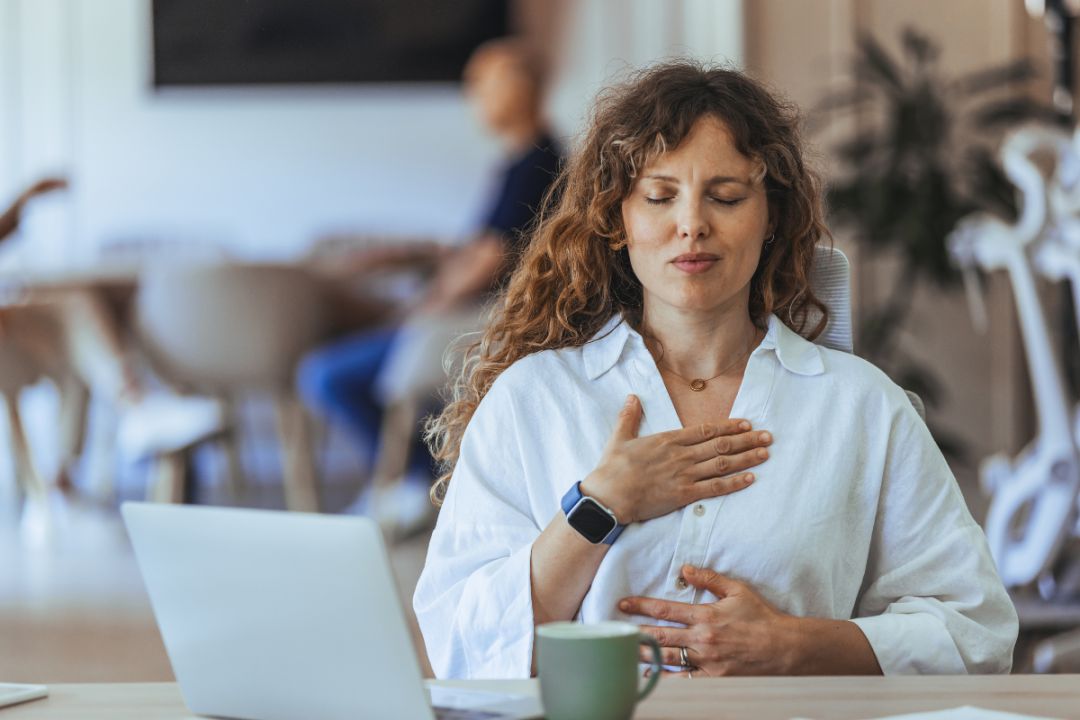
Anxiety can feel diffuse — as though your edges have blurred. Thoughts spill outward. Attention scatters. There’s a sense of being pulled beyond yourself. Grounding practices work not because they are trendy, but because they restore containment. When Reading demonstrates a simple gesture — cupping the chin gently in warm hands, or holding the hand on the heart while breathing deeply — the effect is surprisingly powerful. “These are grounding practices,” she explains. “They tell your body where it is in space, where it ends and the environment around it begins. So this is like a feeling of containment.”
Containment is psychological as much as physical. It is the sensation of being held within your own boundaries. All of these gestures — pressing your feet into the floor, rubbing your palms together, placing a steady hand against your chest — send information to the brain. “When you do anything like just feeling your feet on the floor or rubbing your hands against your thighs,” she says, “it tells your body where it is in space.” And from that awareness, emotional steadiness can begin to return, and you can feel the impact as you calm your body..
“There’s something fundamental that happens within us when we do things like, ‘I’m just going to put a hand on my heart,’” she adds. “There’s a change of relationship with self.” It may look small from the outside. Internally, it can be significant.
Images: Shutterstock