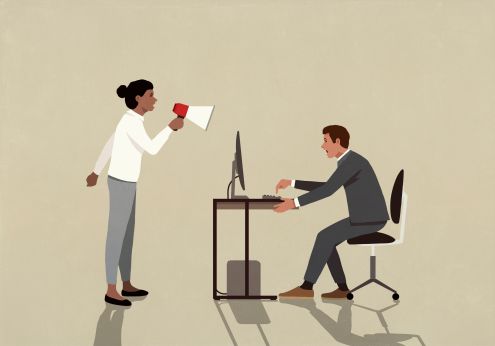
On the brink of burnout? How to spot the signs and set healthier boundaries at work
'Being good at your job shouldn't require sacrificing your health, relationships or wellbeing.'
By 

Feeling frazzled, overwhelmed or wiped out? Here’s how to spot when you might be on the road to burnout, plus some expert advice on setting healthier boundaries at work.
Experts describe ‘burnout’ a state of complete overwhelm, exhaustion and depletion, caused by high levels of prolonged stress. It can present differently in each person, with some people appearing tired and numb and others becoming more urgent or erratic.
‘Burnout is complete disconnection from yourself,’ explains Megan Stachini, business leader, coach and founder of Intrinsic. ‘It is a complete capacity depletion – living completely unaligned, no recovery, living in survival and working for safety.’
‘When burnout hits, everything becomes blunted,’ adds Jo-Robinson Howarth, advanced hypnotherapist, mindfulness practitioner and founder of The Happiness Club. ‘Your emotions are blunted, energy is blunted and you can become detached and disengaged from your work and life.’
What causes burnout?
‘Burnout is caused by extreme stress, especially in the workplace,’ explains Jo. ‘Relentless deadlines, growing workloads, lack of support, company culture – all these things contribute to stress, and if they are not addressed, then burnout is almost inevitable.’
If you tend to be a bit of a people-pleaser, you might be more likely to slip into burnout-causing tendencies at work, such as regularly working overtime or taking on too much. While you might feel in control at first, this can quickly spiral if your employer starts to take advantage of you.
‘One of the biggest signs you’re being taken advantage of at work is that the more you give, the more is expected of you,’ explains Megan. ‘You’re the one that everyone turns to, the one everyone relies on.’
If that sounds familiar, Jo recommends asking yourself how supported you feel in your workplace. ‘Are there systems in place that mean you can report what you are experiencing and are people really listening to those reports?’ she asks. ‘The key point really is in how the company is responding to your concerns and, indeed, if you even feel able to raise concerns in the first place.’

What’s the difference between stress and burnout?
While stress causes burnout, they are not the same thing. ‘The main difference between stress and burnout is that stress is about everything being too much – you have too much to do, there’s too much going on, it’s all too much,’ explains Jo. ‘In contrast, burnout is a place of not enough – you are not enough, your energy is not enough – you have gone past that point of being able to juggle any more balls or handle your stress levels.’
If you’re dealing with high levels of prolonged stress, it’s important to listen to your body and look out for the signs of burnout. ‘Start paying attention to changes in your energy, mood, patience, motivation and physical health,’ suggests Megan. ‘If you’re constantly tired, irritable, struggling to switch off, or feeling resentful about work, don’t ignore it. Reconnect and listen to your body – it tells you a lot.’
The importance of setting boundaries at work
To prevent – or heal from – burnout, you need to take steps to set healthier boundaries in your life. ‘Remember, a boundary isn’t about controlling other people,’ Megan explains, ‘it’s about being clear on what you can realistically sustain. One of the biggest shifts is recognising that your value doesn’t come from how much you can carry. Being good at your job shouldn’t require sacrificing your health, relationships or wellbeing.’
‘For me, it is all about looking after yourself proactively and continuously, prioritising your mental, physical and emotional health above everything else,’ Jo explains. ‘That is the one major boundary that every human being could do with setting for themselves. When you look after yourself, you reduce the likelihood of burnout coming to call.’
What if I don’t feel like I can speak up at work?
If your workplace is putting you under relentless pressure, the idea of speaking up and setting boundaries can feel daunting. But if your company’s culture doesn’t allow room for you to speak up, and an employer shows zero regard for your wellbeing, it might be time to start looking around for another role.
‘If you are fearful of speaking up, then maybe that workplace isn’t for you,’ says Jo. ‘The workplace arrangement has to be a two way street: that company needs you to achieve their objectives just as much as you need them to pay your wages, so it has to work for both parties.’
‘Your health is the most important thing you have – nothing is worth losing it over,’ Megan agrees. ‘You are worth more than a job. If your employer can’t understand that, then they are not the employer for you anyway!’

Small steps to ease stress and prevent burnout
Alongside setting boundaries, try incorporating these small habits into your everyday working routine. Over time, these small steps can help to prevent your stress from becoming chronic and causing total burnout.
Stop and breathe
‘Whenever you start to feel that sense of overwhelm, stop whatever you are doing and take a lovely slow deep breath in. Then, release it really slowly and gently,’ Jo recommends. ‘You could count in for 4, hold for 2, breathe out for 4. The key thing is to breathe in as slowly and deeply as you can. Do that as many times as you need to to bring your nervous system back into a state of calm.’
Take regular breaks
‘Make sure that you build in little short breaks into your day on a regular basis,’ says Jo. ‘We think we have to keep going and going and doing and doing. But the best thing for us is to grab five minutes here or ten minutes there to get up, walk, grab a cuppa or have a chat. Build those breaks into your day between work tasks to reset. We are not meant to work 100 miles an hour constantly – and if we do, we will break.’

Megan Stachini is a coach, business leader, founder of Intrinsic and creator of the Mind-Body and Business Connection Method. She works with leaders and entrepreneurs who are thriving on the outside and running on empty within.

Jo-Robinson Howarth is an advanced hypnotherapist, mindfulness practitioner and founder of The Happiness Club. Over the past decade, she ahs helped thousands of people build calm, confidence and resilience using small, practical shifts that fit busy lives.