Why We First Think Zebras Are Horses – What the Brain Teaches Us About Change, Identity, and Becoming
Have you ever made a meaningful change in your life - a new role, a new boundary, a new way of being - and quietly wondered, Why does this feel so strange if it’s meant to be right? You may be more at home in this transition than you realise. The answer lies in how the brain makes sense of the unfamiliar. How we may first mistake zebras for horses... but wait... as that is only the first step.

The Zebra Moment
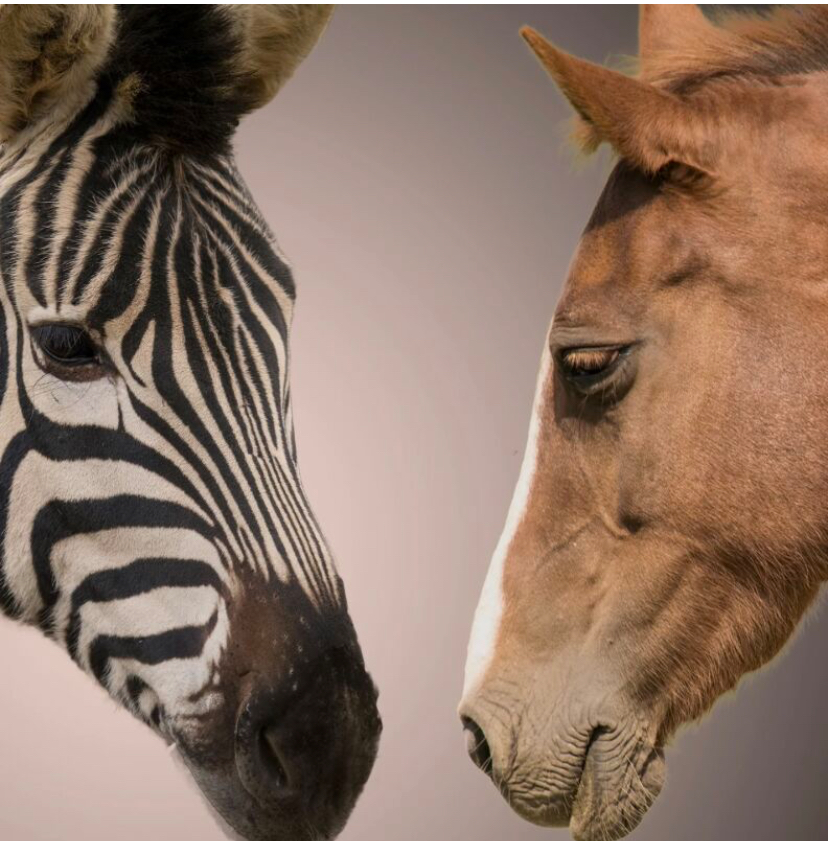
The first time many of us see a zebra, something subtle but fascinating happens. Before the stripes fully register, the body shape already feels known. Four legs. Mane. Hooves. The nervous system moves faster than conscious thought and reaches for a familiar category: horse.
Only a moment later does the mind correct itself.
Not a horse. A zebra.
This brief pause — almost imperceptible — reveals something profound about how humans adapt, grow, and change.
The Brain’s First Priority Is Safety, Not Accuracy
Our brains are not designed to welcome novelty. They are designed to keep us safe. When we encounter something unfamiliar, the brain does not immediately ask, What is this?
It asks, What is this most like?
This is pattern recognition at work — a deeply intelligent survival mechanism. By linking the unknown to something familiar, the nervous system reduces uncertainty and creates a sense of safety. Only once safety is established can curiosity and learning follow.
Mistaking a zebra for a horse is not an error.
It is the brain building a bridge.
Why Change Feels Uncomfortable – Even When It’s Right
In my work as a coach, I see this “zebra moment” play out every day. A client steps out of an identity that once defined them:
- the high achiever who no longer wants to live in burnout
- the caregiver learning to take up space
- the leader moving from control to trust
- the parent rediscovering who they are beyond the role
Early on, the new way of being feels awkward, fragile, even artificial.
“I don’t feel like myself,” they say.
Or, “This doesn’t feel natural yet.”
Of course it doesn’t.
The brain is still trying to understand the stripes.
Recognition Is Not Integration
There is an important psychological distinction between recognising change and integrating it.
Recognition is cognitive.
Integration is embodied.
We can understand a new belief or behaviour long before our nervous system accepts it as normal.
Neuroscience tells us that the brain relies on existing neural pathways to interpret new experiences. Creating new pathways – a process known as neuroplasticity – requires time, repetition, and emotional safety.
This is why insight alone rarely creates lasting transformation.
The body needs evidence.
The nervous system needs consistency.
Only then does the new become familiar.
Only then does the zebra become a zebra.
The Discomfort of the In-Between
This is the phase where many people become self-critical.
They ask:
Am I going backwards?
Did I make the wrong decision?
Why does this feel harder than before?
But these questions are not signs of failure. They are signs of transition. The psyche is recalibrating. The nervous system is learning a new pattern. The old category no longer fits – but the new one has not yet settled.
This in-between is not something to fix.
It is something to respect.
When We Pathologise What Is Actually Normal
As a culture, we are often uncomfortable with liminal spaces – the undefined middle where certainty has not yet arrived.
We are quick to label the discomfort:
- resistance
- lack of confidence
- imposter syndrome
- self-sabotage
Yet more often than not, what we are witnessing is integration in progress.
A system learning how to hold something new.
This is not weakness.
It is adaptation.
Normal Is Not the Beginning – It Is the Outcome
We tend to assume that if something were truly aligned, it would feel normal straight away.
Psychologically, the opposite is true.
What now feels natural was once unfamiliar:
- speaking up
- resting without guilt
- trusting your own judgement
- living with greater self-honesty
Every integrated part of you was once a zebra mistaken for a horse.
My Final Reflection for 2025…
If you recognised yourself in the zebra – if you have ever felt misunderstood, simplified, or not quite seen for who you truly are – you are not alone.
I know this landscape well. I experience it myself more than I would like to admit.
People often see labels before they see essence. Roles before reality. Familiar shapes before unique stripes. And yet, what makes us who we are is rarely obvious at first glance.
I share this not so you understand me, but so you understand yourself more gently.
Because if you are in a season where:
- you feel different, but not yet settled
- you look successful on the outside, but uncertain on the inside
- you sense a deeper truth emerging, even if you can’t yet articulate it
then nothing may be wrong.
Your brain may simply still be learning the stripes.
And with time, patience, and the right space to grow, what feels unfamiliar today can become the most natural way you have ever lived.
If you are seeking to be met where you are — and to be accompanied, without pressure, from where you stand now to where you sense you want to go — know that I am available and ready to walk beside you. This is the work I do as a coach.
I hope to see you in 2026.
And if our paths cross, if we find each other, I would be honoured to walk with you.
BTW – I am the Zebra (not the horse) in Switzerland! Wishing you a wonderful Christmas time with you and yours.
Sarah
Sarah Cretegny. ICF ACC Accredited Coach, Trained Team Coach and Founder of Coach Your Wild. My coaching practice is a creative oasis in the wildness of life – your thinking partner for what matters most. I am committed to making personal and professional development accessible and transformational, especially for those making a meaningful impact. Based in Lausanne, Switzerland, and coaching globally. www.coachyourwild.com

Coach Your Wild – Sarah Cretegny
Transitions Coach
Sarah Cretegny is a Transitions Coach, Founder of Coach Your Wild. and Author of "The Wild Within - Finding yourself in times of change." Sarah works alongside people navigating changes in their role, work or world, creating space to reconnect with who they are, notice what matters now and find their own way forward. Originally from the UK and now living in Switzerland with her husband and three teenage children, Sarah has personally navigated changing countries, careers, roles and seasons of life. Through Coach Your Wild, she offers 1:1 coaching virtually, in person and through walking coaching. Something changing in your role, work or world? Start with one conversation. Coaching for real life. Real transitions. The real you. Coach Your Wild is a creative oasis in the wildness of life – your thinking partner for what matters most. International Coaching Federation Associate Certified Coach, Gallup certified CliftonStrengths Coach and Postgraduate Certificate in Business and Personal Coaching.