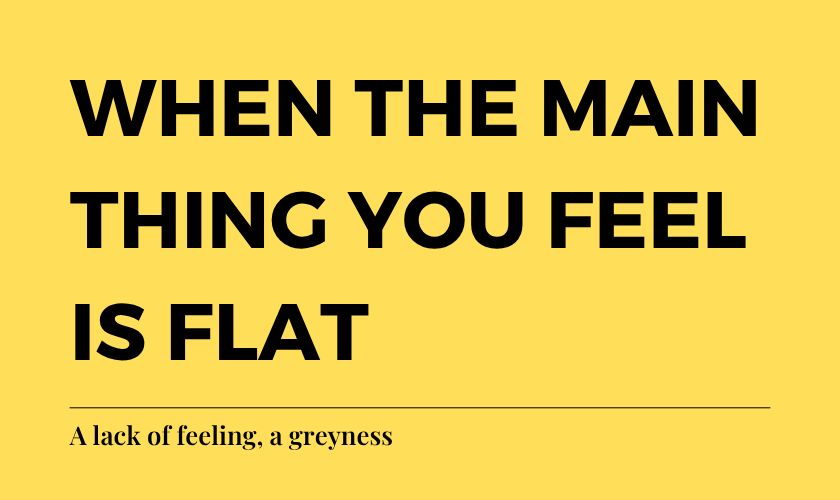
When the main thing you feel is flat: a lack of feeling, a greyness

There are some feelings we tend to understand more than others. Typically, we know how anger feels: tension, heat, clenched muscles. We know how anxiety feels: tension, churning stomach, fidgety. We know how sadness feels: heavy, tearful, weight in the pit of the stomach.
However, sometimes the main issue is actually a lack of feeling. A sense of feeling numb or grey. There is often the sense that there is sadness somewhere in the back of things here, but that ultimately it is more about a lack of feeling, that the world has lost it’s colour.
The word we will use to describe this sometimes is “flat.”
If we are angry, we can say “what’s making me feel angry?” and we might be able to dig into it. Typically it will be about feeling wronged or trodden on. With anxiety we can ask the same thing, and it will be about a sense that something might go wrong. Sadness is likely to be to do with missing someone or something, feeling alone, hurt or that things are not what we hoped they would be.
“What’s making me feel flat?” is a harder one to answer, perhaps because we aren’t as familiar with it, or perhaps because it feels like a lack of emotions, rather than a feeling in and of itself.
However, it does make more sense once we understand a little bit about it. Typically, the flat feeling comes when things seem hopeless, we feel helpless, or when we are just ground down and are out of energy.
When we can’t see a way out, when we can see a way out but we don’t feel able to take it, or when we have been fighting or striving for so long but don’t feel like we are getting anywhere, that’s when we feel flat. We might also feel that way in response to a loss.
It comes with a physical feeling of heaviness and exhaustion, like you just want to lie down. It also comes with a numb feeling, or a sense that things just don’t mean as much as they should. It’s hard to feel enthusiastic and hard to take joy from things in the same way that you usually would.
Flat is the dominant feeling in depression. There might be sadness, anger, anxiety and all sorts of other things mixed in there too, but the main thing is often feeling stuck, heavy and flat, like the colour has drained from the world.
The key thing I would want anybody to know is that this is a common part of the human experience, too. There is a theory that this is an in-built response to a situation where we feel that we cannot escape. We might fight for a while, but if it seems hopeless, then the heaviness creeps in.
I described it recently to someone as if a boxer gets knocked down, gets up again, gets knocked down, gets up again, and this continues, eventually, they are going to find it very hard to lift themselves off the canvas.
When it’s loss, we can understand it through that viewpoint of things feeling hopeless, too: sometimes it seems as if things could never be OK again. However we can also see it as things feeling so much less colourful than they used to, or so futile or silly, because in comparison to the loss we feel, perhaps things really do seem tiny and unimportant.
Whatever brings it about, if you can understand it a bit more, then maybe you have a better chance of finding a way out of it. Finding ways of feeling hope, or connection, for example.
It does make sense as a feeling. Much more sense than it might seem.
Thanks for reading. Until next time,
Ted
P.S. Another hard part of it is that while you feel flat, the things you would usually do to feel better (seeing people, doing things you like, etc) have less of an effect, because it is hard to enjoy them in the way you usually would. That doesn’t mean they aren’t worth doing; it might just be a little while before you get as much from them as you used to.

Ted Bradshaw
Cognitive Behavioural Therapist and Coach
My name is Ted Bradshaw (@cbtted on Instagram and TikTok) and my main aim is to make mental health and anxiety in particular much easier to understand. I am a Cognitive Behavioural Therapist accredited by the BABCP and have been working in this area for over 15 years. I am an honorary Assistant Professor of Psychological Therapies at the University of Nottingham and I also work as a coach, accredited by the International Coaching Federation to PCC level. On my first day of training as a therapist, I was immediately annoyed. The things I was learning seemed so useful, and I was confused as to why I had never been taught any of this before, because it would have been so useful. For me, it seemed ridiculous that we would wait until people feel really bad before we offer them any information or insight into how anxiety or how a mind works. That is what led me to look into coaching and it is also why I spend a good deal of my time writing about and making short videos on lots of different aspects of mental health and anxiety in particular. As a parent, I have also found that what I know about anxiety has been so useful to me when dealing with my own children, so a lot of my focus is upon parents understanding anxiety for their children, too. These days in my 1:1 work with enduring mental health issues such as depression. OCD or PTSD, and I also work with people who might not be sure whether it is therapy they need but who are looking to improve something, like confidence or self-esteem. Finally, I also run workshops for schools and businesses on all of these subjects, including how to help an anxious child, good mental health in the workplace and more. You can find me across most social media platforms @cbtted, on Instagram and TikTok in particular.