The Return of Wildflowers: What Cities – and Humans – Are Quietly Remembering
Wildflowers are quietly reclaiming our cities, reminding us that growth doesn’t require perfect conditions—only the courage to emerge when the ground shifts. What if the uncertainty in your own life isn’t something to fix, but the very place where your most authentic growth is beginning?

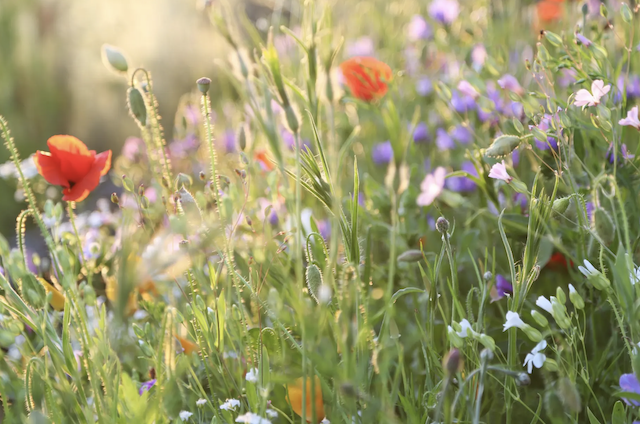
There’s something quietly rebellious about a wildflower. No one plants it. No one tends it. And yet – it grows.
You’ll find it pushing through cracks in the pavement, softening the edges of forgotten spaces, reclaiming corners of cities we thought were too hard, too polluted, too finished for life to return. And still, it does.
This quiet return of wildflowers to our urban landscapes is more than a trend in ecological restoration. It’s a reminder. Not just of nature’s resilience – but I believe of our own.
They Were Always There
Wildflowers don’t need perfect conditions. In fact, they’re designed for the opposite. They thrive in disruption. In disturbed soil. In places where the ground has been turned over, broken open, or left untended.
For years, we’ve believed that growth requires control – careful planning, the right environment, ideal timing. We’ve landscaped our cities the way we often try to manage our lives: neat, predictable, contained.
But wildflowers tell a different story.
They remind us that not all growth is cultivated. Some of it is remembered.
The Intelligence of Unstable Ground
In ecology, disturbed environments are often the most fertile for new life. Seeds lie dormant in the soil—sometimes for years—waiting not for perfection, but for disruption.
It’s the digging, the breaking, the unexpected shift that creates the conditions for them to emerge.
What if the same were true for us?
What if the seasons that feel the most uncertain – the move, the loss, the identity shift, the moment where what once felt solid begins to crack – are not the end of growth, but the very beginning of it?
As humans, we often resist instability.
We try to fix it, smooth it over, return to what was. But there is a deeper intelligence at work – one that understands that transformation rarely happens on steady ground.
You Don’t Need to Be Planted to Grow
Wildflowers are not placed with intention. They are not given permission. They grow because it is in their nature to grow. And somewhere along the way, many of us have forgotten that this is true for us too.
We’ve been taught that we need the right qualifications, the right moment, the right environment before we can begin. That we need to be “ready.” But readiness is often a myth.
Growth is not something we earn – it’s something we are designed for. Like wildflowers, we carry seeds within us: of creativity, of courage, of reinvention, of meaning. And those seeds don’t disappear when life becomes uncertain. If anything, uncertainty is what wakes them up.
Rewilding the Self
There’s a quiet movement happening in our cities – less mowing, more letting be. A willingness to allow spaces to grow a little wilder, a little less controlled.
Not because we’ve given up – but because we’re beginning to trust what happens when we do.
What if we offered ourselves the same permission?
To not have everything figured out.
To grow in unexpected directions.
To emerge in places we didn’t plan.
To trust that even in the cracks—especially in the cracks—something meaningful can take root.
Coach Your Wild
In my work as a coach, I often meet people in seasons of disruption. On the surface, it can look like things are falling apart. But beneath that, something else is happening.
The ground is shifting.
Old identities are loosening.
New possibilities are being created.
These are not signs of failure. They are signs of life.
The invitation is not to rush back to stability, but to stay curious in the instability. To listen for what is trying to grow.
Because, just like the wildflowers returning to our cities, you don’t need to be planted in perfect conditions to flourish. You were designed for this.
If this resonates, I’d love to hear where life feels a little “wild” for you right now. That’s often where the most honest growth begins.
I’m Sarah Cretegny, an Accredited Transformational Transitions Coach and Collaboration Catalyst. I create brave spaces where individuals, leaders and their teams – especially those committed to meaningful impact – can reconnect with who they truly are, so they can lead with greater clarity, courage, and purpose, even in uncertain times, and create sustainable impact.
I’m particularly effective when time is limited and the stakes are high. I draw on evidence-based coaching approaches, strengths expertise, and my lived experience of balancing leadership, family life, and international living. I’m deeply passionate about partnering with people to coach their wild, because the world needs more authentic leadership now more than ever.
I live in Lausanne, Switzerland and coach virtually globally. I`m known as the zebra in Switzerland. Drop me a line, I love to connect. www.coachyourwild.com

Coach Your Wild – Sarah Cretegny
Transitions Coach
Sarah Cretegny is a Transitions Coach, Founder of Coach Your Wild. and Author of "The Wild Within - Finding yourself in times of change." Sarah works alongside people navigating changes in their role, work or world, creating space to reconnect with who they are, notice what matters now and find their own way forward. Originally from the UK and now living in Switzerland with her husband and three teenage children, Sarah has personally navigated changing countries, careers, roles and seasons of life. Through Coach Your Wild, she offers 1:1 coaching virtually, in person and through walking coaching. Something changing in your role, work or world? Start with one conversation. Coaching for real life. Real transitions. The real you. Coach Your Wild is a creative oasis in the wildness of life – your thinking partner for what matters most. International Coaching Federation Associate Certified Coach, Gallup certified CliftonStrengths Coach and Postgraduate Certificate in Business and Personal Coaching.