
Why am I always so critical? How to overcome a judgemental mindset
Do you often find yourself being overly critical of strangers? We take a closer look at what downward social comparison is, before exploring how to stop it in its tracks...
By  Psychologies

Judging strangers came easily to DJ Bowman-Smith. It was fun, and it made her feel better about herself. Then a comment from her daughter left her determined to change
The radio was playing, the sun was out and I was in a happy mood. My daughter was home for a few days and we were on our way out to lunch. While we waited at the traffic lights, a woman and her dog crossed the road. ‘The rest of her clothes must be in the wash,’ I said. ‘And let’s hope she’s on her way to the hairdresser!’
My daughter said nothing. ‘Funny how people end up looking like their pets,’ I added. The dog was large and ugly. I glanced at my daughter. I thought she must be checking her phone since she hadn’t replied, but she was just staring ahead.
We drove on in silence and then she said, ‘I bet that dog is really friendly. The woman has probably just popped out to get some fresh bread in her gardening clothes. Nice to have such thick hair.’
My daughter didn’t call me out over my unkindness, instead she gently realigned my thoughts. With the benefit of her perspective, I saw the woman differently: no longer a scruff – but a busy gardener dashing out with her friendly dog for a loaf – and yes, what lovely hair.

Recognising your critical voice
I realised that what I’d said was unwarranted. The incident stayed with me and I started to notice that even when I didn’t have an audience, I thought negatively about people. When I walked behind someone in the street or watched TV, I was constantly finding fault in my head.
It didn’t chime with my self-image. I saw myself as an optimistic and upbeat person – so what was going on?
I asked both my daughters if they thought I was overcritical – and their honesty shocked me. They said I was kind about family and people I knew, but always horrible about strangers. ‘You should work on it,’ said my youngest, and I knew she was right. I did some research and discovered the concept of ‘downward social comparison’.
What is downward social comparison?
This is when a person finds fault in others, often strangers, as a way of making themselves feel better. In a study led by Dustin Wood, a professor of psychology and research fellow at the University of Alabama, students were asked to rate their peers. Those who gave generous ratings had kinder characteristics and better mental health.
‘Seeing others positively reveals our positive traits,’ said Wood, and the reverse was also true. Those who looked for positive traits were perceived to possess those same qualities – and the negatively minded were similarly judged.
I contacted Wood and asked why some of us harbour a critical mindset that leads to downward social comparison. The most common reason, he said, is a learned response from our families and upbringing.
‘Our experiences with caregivers serve as a working model for the behaviour we expect of others.’ I could certainly see this in my early family life. Criticising each other and everyone else was the norm, something I assimilated to such an extent that it became second nature.

What’s at the root of this critical mindset?
Wood explained that another way a person can develop a critical mindset is through a traumatic event, such as a mugging. This can have ‘a poisoning effect’, he said, by establishing mistrust of people. When this happens, acts of kindness go a long way to mending that wariness. ‘Positive experiences with others help those with a fearing and critical mindset,’ he added.
Then I had a revelation. An old friend held a charity coffee morning, and I was in the company of women I did not know. One of them told a cutting story about somebody she knew. She was funny and we all laughed. But as I walked home, I decided I didn’t like her. I thought she had the very traits she condemned in her ‘friend’. Moreover, I feared she would find fault with me as well.
Her judgmentalism made me cautious, and I realised my reaction to her was probably how people reacted to me. I was experiencing what Wood’s research showed – that the way we perceive others is often the way others see us. If we think the worst of them, that is how they will think of us.
I realised that the harsh way I judged strangers was about my fear of how they might view me. It was a defence mechanism – a way of dealing with the unknown. This led me to another realisation: my intrinsic self-doubt. It could have been me telling that story at the coffee morning because, just for a moment, judging someone else would make me feel better about myself.
After that, it wasn’t hard to see that what I fear in myself, I criticise in others. Many of my comments focus on appearance. I will criticise the way you look before you criticise me. It’s a defensive game, and it isn’t making anyone any happier, myself included.
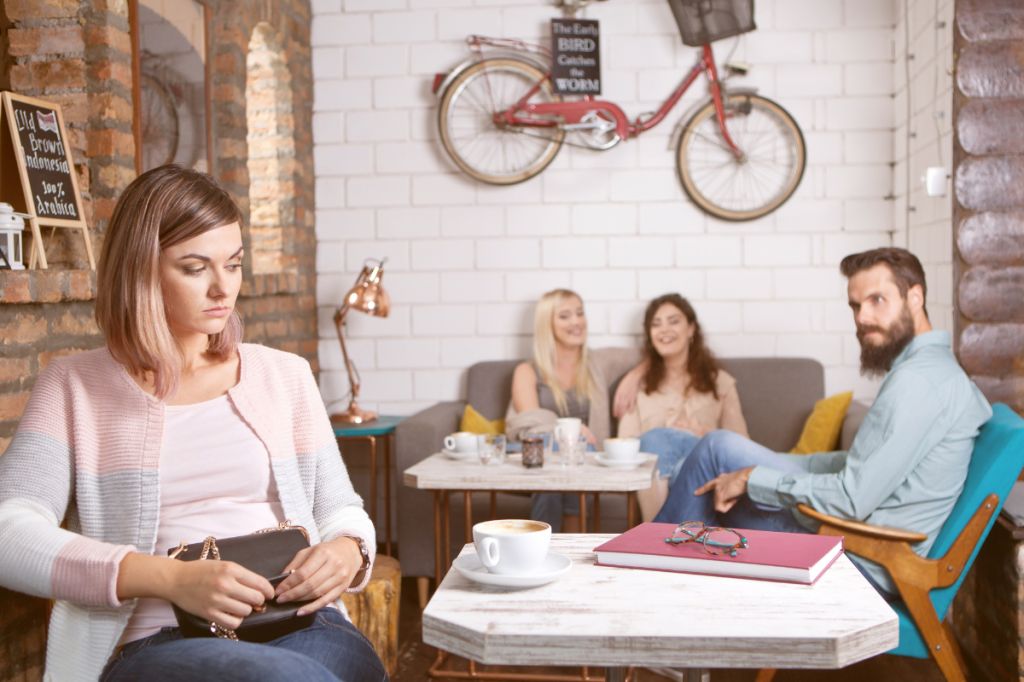
How to stop being so critical of others
So, how can we overcome downward social comparison and stop being so critical? We could try to change the way we think, but old habits are persistent. Wood’s research found that whether a person had a positive or negative attitude was a ‘highly stable trait’ – quite fixed, which made me despondent.
But he reassured me that change is possible. He suggested I ‘come up with better ways of approaching people that might elicit more positive behaviour’. He also recommended spending more time with kind-hearted, non-judgmental people – like my daughters.
Trying to change
I practised challenging my thoughts while sitting in traffic. A woman passed by and I vocalised my first impressions, which were mean and judgmental. I forced myself to find something about her that I liked, but the process was challenging.
Then she smiled at me, and I smiled back. ‘Friendly,’ I said. ‘Nice smile.’ I realised this stranger had not judged me. I felt no hostility from her, just warm acceptance.
When another person passed, I smiled first and they returned the gesture. It was a warm feeling – like opening a door. It’s not easy changing fixed patterns of thinking, but I kept practising. Slowly, as I replaced negative thoughts with caring ones, I felt happier and more open.
As I put aside my fear of how others will criticise me, I saw beyond clothes and hair to the human being inside – imperfect, just like me. And I felt better in myself. Wood said, ‘I think there is a sort of bank of trust in others that can be contributed to or depleted by how others interact with us.’ I now understand how true that is.