I let AI into my life — and then I started to doubt my own intelligence
By  Psychologies

I finally embraced artificial intelligence as a helpful tool. But as AI took over my routine, I began to wonder if it was slowly eroding my trust in my own voice.
I’ve worked in film and TV as a writer for the past 20 years, and never have I doubted my own brain as much as this past year. It took me longer than most to cave in to using AI. It felt insidious to me from the beginning. There were huge concerns that it would mean the end of my trade, that it would be disastrous for the environment and for the economy, as artificial intelligence took over most roles of the population. On top of it all, I’d have to learn a new skill in order to join the jeopardisation of my own craft!
But as the noise and chatter about how useful it can be grew louder, I started to hear how freeing of time and energy AI was: how it simply took over the menial or complicated tasks, allowing us more time to deal with the important aspects of our work and lives.
I started to wonder what I was missing and, one day, I caved.
How AI became part of my daily routine
To my surprise I got the hang of it rather quickly, and was soon using it to a greater or lesser extent every day. At first it was simply to check my spelling and grammar. To be honest, this felt like a life-saver. All the errors I feared, and some that I’d not even considered, flagged right on up there. A great proofreading tool indeed. ‘This is amazing,’ I thought. My friends were right.
Then, I began using it to fact-check, and to brain dump. Soon, I was using AI to help craft pitches for new film or TV ideas. I started asking it all sorts of questions. Could it make story suggestions? Streamline my thoughts more efficiently? Eliminate any plot holes?
Here I was, hurtling down the rabbit hole, until it finally hit me… For the last few months, I’d been relying on AI almost completely.
And not just in my work — I now couldn’t remember the last time I hadn’t used it to help polish an email, check for typos or research into something — which I previously loved doing myself.
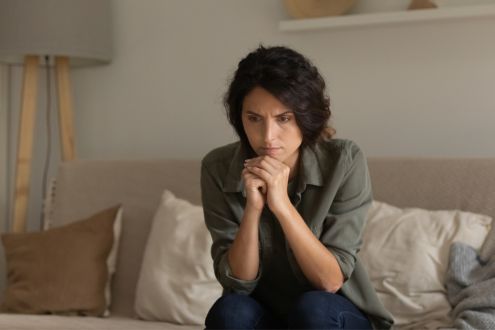
I was consistently second-guessing my own gut instincts, my own authentic voice, thinking that every sentence I wrote needed to be altered before it could be read by another human being. I had succumbed to the belittling belief that nothing my own brain could conjure up would ever be as good as what AI said. Even when I didn’t think what AI came up with was actually that good, I had started to doubt my own, instinctive, human voice.

The benefits — and risks — of artificial intelligence
I do think AI can have its uses. There is an argument that it can be used to bridge the socioeconomic gap in terms of education.
For those seeking clarity or sense in the chaos of a whirling mind, I can also see how AI can be quite comforting — sometimes. I am autistic and can struggle to communicate effectively what’s in my head. Being able to bounce my thoughts back and forth with a non-judgemental word processor can be helpful.
But could the greater societal reliance be adding to the general noise in our heads and gradually undermining our own sense of self, our trust in ourselves as sentient beings?
Educational, child and adolescent psychologist Dr Julia Alfano says: ‘The focus on the move towards this “techno-bureaucratic” practice is often linked to short cuts, resulting in quick answers.’
However, she adds: ‘Without information being subject to active, conscious critical appraisal we are not open to revaluation of the information we are presented with. In a word, we stop being curious, we stop questioning and we are no longer engaged in an active discourse.
‘As a result, the information itself takes on an individual reality or truth, and we have lost our agency over it.’

What we lose when we stop trusting ourselves
I personally miss the days when I didn’t know the answer to a question, or I needed a ‘fact’, and I would trawl though my network of experts and friends, buy them a coffee and… talk!
As Dr Alfano explains, human interaction opens up connectivity, opportunity, friends, and new worlds. We learn from the ground up, we grow, rooted. We experience differences of opinion, maybe we even change our mind about something after a particularly meaningful conversation.
Keeping a sense of our human self feels like an important lesson here, because if we start to believe that our minds, thoughts and opinions have no value, then soon we shall be proved right.
We need to keep an eye on our instincts to ‘double-check’. Perhaps, the next time we find ourselves doubting our email, or our text or our own work, before we open Copilot or ChatGPT we should ask ourselves… ‘A few years ago, would I have trusted myself to say this?’

Why imperfection still matters
There was a time I once trusted myself more than anyone in the world. I had never trained in the industry I ended up in, so I wrote from instinct, from somewhere unpolished, but truthful.
Yes, my work might have been formatted wrong, my emails might have been too eager, too personal. But the flaws in my work were real. It was in a way integral to my message — it said loud and clear in my excitable, error-ridden way that I am flawed, I am human.
I am tempted, even now, to put this through AI. Of course I am tempted. I ate the apple.
But I won’t. Because for me, I am terrified by the thought that even when the perfect job comes up, a lot of us now won’t apply for it… because what is the point anymore, who can compete with a robot?
Who can compete with perfect? In my mind, all of us can. Because, surely, being imperfect, is what makes us human. And being human, in all its messy, flawed ways, feels like one of the most important things we can offer the world right now.
Meet the Expert Dr Julia Alfano is an educational, child and adolescent psychologist based in Surrey
Words: Elizabeth Allen. Images: Shutterstock