As AI makes life easier, are we forgetting how to do hard things?
Artificial intelligence is increasingly doing the difficult things for us — from navigating our journeys to parking our cars. But as life becomes easier, an important question emerges: what happens to our confidence, resilience and ability to grow if we stop practising the hard things ourselves?

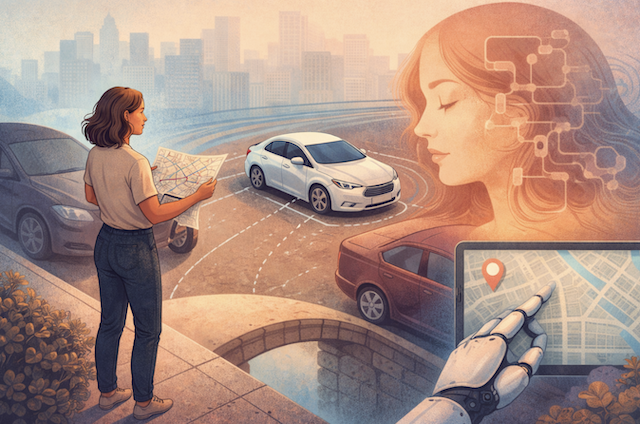
This weekend, as we were looking for a parking space, my husband suddenly remembered something. “The car can park itself,” he said. I had completely forgotten.
With the press of a button, the car began scanning the parking and identifying a space between two vehicles. Sensors measured the distance, the steering wheel started turning on its own, and within seconds my eldest daughter and I had jumped out of the car!
Our reactions were different.
My husband and 2 other children stayed calm and curious.
My daughter and I instinctively stepped out.
After an initial moment of reorientation and watching the car glide neatly into the space, a quiet question sparked in my mind.
If the car does this often enough… will we eventually forget how to do it ourselves?
And what happens now there are cars fully AI-driven?
In some parts of the world, this future has already arrived. In several cities it is now possible to open an app and call a completely AI-powered taxi with no human driver at all. The vehicle arrives, the door opens, and the journey begins.
For many people this already feels normal.
For others, it still feels slightly surreal.
The Age of Effortless Living
Artificial intelligence is designed to make things easier.
Navigation apps mean we rarely read maps.
Autocorrect fixes spelling before we notice mistakes.
Algorithms recommend what to watch, buy or listen to next.
Increasingly, technology anticipates our needs and removes friction from everyday tasks.
In many ways this is a gift. These tools save time, reduce stress and allow us to focus on other priorities.
Yet there is a subtle paradox.
The very moments that once felt frustrating were often the moments that helped us humans to grow more capable.
Think about the first time you successfully parallel parked after weeks of awkward attempts.
Or navigating a new city using nothing but a paper map and your own sense of direction.
Psychologists call this sense of capability self-efficacy — the belief that we can handle challenges and solve problems.
Like any muscle, it grows stronger through use.
When difficulty disappears from our daily lives, we gain convenience.
But we may also lose some of the opportunities that once helped build confidence and resilience.
Who Is Designing the Future?
Artificial intelligence is not neutral.
It reflects the people who design it and adopt it.
Today the development and uptake of AI technologies remains heavily male-dominated. Across the technology sector, men are significantly more represented in AI development and are often earlier adopters of new AI tools.
That imbalance matters.
Because the way humans interact with technology is not purely logical.
It is also sensory.
When my daughter and I stepped out of the car, it wasn’t because we didn’t understand the technology. Something in our bodies simply said: not yet.
Women often process risk and uncertainty differently, taking in subtle cues from the environment before trusting a system completely.
This form of sensory intelligence is rarely discussed in technology design — yet it may be essential for how we responsibly integrate powerful tools like AI into daily life.
The question is not only how fast we adopt technology.
It is whether all forms of human intelligence are being heard in shaping it.
The Value of Tension
At the heart of many difficult experiences lies something psychologists might call tension.
The tension between not knowing and figuring something out.
The tension between uncertainty and clarity.
The tension between the person we are today and the person we are becoming.
Artificial intelligence often works to remove that tension quickly.
If something feels complicated, technology offers a shortcut.
If something feels uncertain, it provides an answer.
And in many situations this is enormously helpful.
But growth rarely happens in comfort.
It happens in the stretch — the space between where we are and where we want to be.
Learning a language.
Changing careers.
Starting a business.
Navigating a major life transition.
These experiences are rarely easy.
Yet it is often precisely in that uncomfortable space that transformation begins.
The Human Skill of Holding the Tension
In coaching, there is an important principle.
We do not rush to remove tension too quickly.
When someone is facing uncertainty, many people instinctively offer advice or solutions.
But meaningful change often requires something different.
Time to reflect.
Space to explore.
And the ability to listen to one’s own thinking.
Sometimes the most valuable thing we can do — as a coach, a friend or simply a thoughtful human being — is to hold the space for a little longer.
Insight often arrives not when tension disappears, but when we stay with it long enough to understand what it is asking of us.
In a world increasingly designed to remove friction, this may become an even more valuable human skill.
Three Ways to Keep Your “Hard Things” Muscle Strong
We don’t need to reject technology.
AND we can remain intentional about how we live alongside it.
- Occasionally choose effort over automation
Navigate somewhere without GPS.
Learn a new skill from the beginning.
Solve a problem before asking AI for the answer.
- Listen to your own signals
Technology prioritises speed and efficiency.
Human beings also rely on intuition, perception and embodied awareness.
Those signals are part of wise decision-making.
- Practice small acts of courage
Initiate a conversation you’ve been avoiding.
Try something unfamiliar.
Stay with a challenge a little longer before outsourcing it.
These moments remind us that we are capable of more than we sometimes believe.
The Quiet Satisfaction of Doing Something Difficult
Automatic parking isn’t the problem.
And highways of fully autonomous cars may eventually make driving safer and more efficient.
Few of us would willingly give up tools that genuinely improve our lives.
Yet it is worth remembering something about the moments that once challenged us.
The awkward attempts.
The concentration.
The quiet satisfaction when we finally succeeded.
Those moments did more than help us park a car.
They built confidence.
Technology will continue to make life smoother and more efficient.
But our sense of capability still grows the way it always has — through practice, effort and the willingness to stay with something difficult long enough to master it.
Perhaps the real question for our increasingly automated world is not simply whether technology can make life easier.
It is this:
What difficult things are we still willing to practice — simply because they help us grow? ✨
I’m Sarah Cretegny, a Personal and Business Development Coach and Collaboration Catalyst. I create brave spaces where creative leaders and their teams – especially those committed to meaningful impact – can reconnect with who they truly are, so they can lead with greater clarity, courage, and purpose, even in uncertain times, and create sustainable impact.
I’m particularly effective when time is limited and the stakes are high. I draw on evidence-based coaching approaches, strengths expertise, and my lived experience of balancing leadership, family life, and international living. I’m deeply passionate about partnering with people to coach their wild, because the world needs more authentic leadership now more than ever.
I live in Lausanne, Switzerland and coach globally. www.coachyourwild.com

Coach Your Wild – Sarah Cretegny
Accredited ICF Coach
I work with people in wild seasons of life - whether you’re navigating a transition, a career change, a shift in life stage, or moving to a new country. As a Certified Coach, I will partner with you to accelerate your path to authentic, fulfilling and sustainable success. Sarah is on a mission to live in a world everybody lives more fulfilling lives more of the time. By reconnec1ng people with their unique W.I.L.D. ™, we can all create the lives we love to live, and together make a meaningful impact in the world. Coach Your Wild is a creative oasis in the wildness of life – your thinking partner for what matters most. Sarah is an Associate Certified Coach and Member of the International Coaching Federation. She has a Post Graduate Certificate in Business and Personal Coaching. Sarah is British, and lives in Switzerland with her husband and 3 teenage children. When not coaching she loves going on adventures with family and friends, as well as enjoying local Swiss wine in the vineyards.