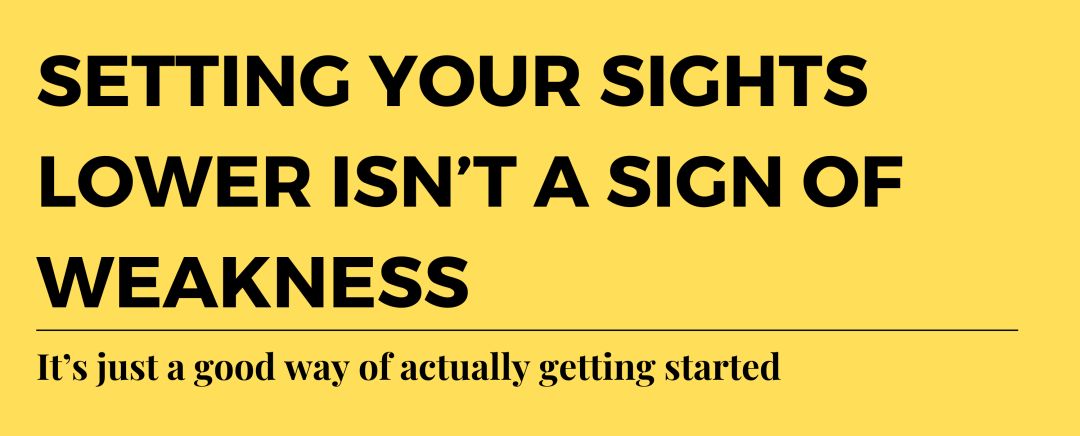
Starting small isn’t a sign of weakness. It’s just a good way of actually getting started.

A couple of years back I went to see a physiotherapist. I had been struggling with my back since my eldest was two weeks old (she’s nearly ten now) after I spent a day lugging her around a hospital in a very heavy seat (we thought it would be a very short visit and didn’t bother with the wheels – rookie mistake). Then that evening, having sat with her asleep on me for an hour or so, I went to stand up and everything seized up on the right side of my neck and down my back.
I’d been doing lots of things (apart from seeing a professional, of course) like stretching and trying to do back-strengthening exercises. I had got by, but when I lost a couple of days because my back and bum cheeks went at the same time after a visit to the trampoline park, I thought it might finally be time to do something about it.
That led me to the physio.
I immediately liked this woman. Direct, funny, happy to poke a little fun. I explained a bit about what was going on, she got me to do a couple of things and then said that she had diagnosed the issue as I walked through the door:
“The problem is, because your back is weak, every time you try and do something that would involve your back, you don’t use your back, you use your trap (I think that is the word she used – a muscle that runs up the side of your neck). Particularly on the one side. So while that one muscle has developed, it isn’t a strong enough muscle to do what is being asked of it, so it keeps getting overloaded. And, in the meantime, your back muscles aren’t being used, so they stay weak.”
She kept using the word weak (because it was factually accurate), and I felt myself physically flinch every time she did. Then felt the disappointment in myself for having such a fragile little ego.
She asked me if I could do a push up, and with my wounded pride I said that of course I could. I showed her and she said “Yes, I can see it. You will be able to do it but because your back is so weak (ouch) it’s not those muscles you are using. It’s all on your neck.”
She proceeded to tell me that I needed to reset what I was trying to do and drop my expectations right down. She told me to do my push ups against the wall, with almost no body weight really going into it, and to concentrate on using the right muscles (and not my flipping neck), and once I could do that, to slowly make it harder, but to not overdo it as that would just push me into using my neck again.
She was so good. She had identified what was going on, told me what was happening, showed me some examples and let me know exactly what I could do about it.
However, the thing she really did for me in those few minutes was make me recognise the fundamental issue: I kept trying things that were too hard, setting myself back, and therefore not getting anywhere. She challenged me to do something I found uncomfortable:
Admit that I wasn’t as strong as I thought I was, and that I wasn’t yet capable of doing the things I wanted to do.
I did do what she said. I changed what I was doing and started from the very beginning. It was frustrating, because I felt like it would take longer to get somewhere, but actually, because I wasn’t constantly making my back seize up, I could actually exercise more often. In slowing down and starting small, I got to get a real feel for when things were starting to get too much and my neck was getting involved, so I knew when to stop.
Now, a couple of years on, I can’t actually tell you the last time my back went. I can do push ups properly, and I can play with my kids (and even manage the trampoline park).
But it didn’t happen through pushing myself as hard as I could. It happened through allowing myself to start really small and make progress gradually.
Starting small isn’t weak. It’s giving yourself permission to actually do something you can actually achieve, rather than setting yourself up to fail.
That’s what my physio gave me.
Well, that and the knowledge that I had some sort of complex about being weak, but you know, there’s therapy for that.
Thanks for reading. Until next week,
Ted
P.S. I’m using this approach right now as it happens. There’s a few big projects I’ve been wanting to do for ages but been procrastinating on because they feel a bit scary and complicated, so I’m aiming to just break them down into pieces and have a go at little bits at a time. In doing so, I’ve got further than I ever have before. Let’s see how that goes.

Ted Bradshaw
Cognitive Behavioural Therapist and Coach
My name is Ted Bradshaw (@cbtted on Instagram and TikTok) and my main aim is to make mental health and anxiety in particular much easier to understand. I am a Cognitive Behavioural Therapist accredited by the BABCP and have been working in this area for over 15 years. I am an honorary Assistant Professor of Psychological Therapies at the University of Nottingham and I also work as a coach, accredited by the International Coaching Federation to PCC level. On my first day of training as a therapist, I was immediately annoyed. The things I was learning seemed so useful, and I was confused as to why I had never been taught any of this before, because it would have been so useful. For me, it seemed ridiculous that we would wait until people feel really bad before we offer them any information or insight into how anxiety or how a mind works. That is what led me to look into coaching and it is also why I spend a good deal of my time writing about and making short videos on lots of different aspects of mental health and anxiety in particular. As a parent, I have also found that what I know about anxiety has been so useful to me when dealing with my own children, so a lot of my focus is upon parents understanding anxiety for their children, too. These days in my 1:1 work with enduring mental health issues such as depression. OCD or PTSD, and I also work with people who might not be sure whether it is therapy they need but who are looking to improve something, like confidence or self-esteem. Finally, I also run workshops for schools and businesses on all of these subjects, including how to help an anxious child, good mental health in the workplace and more. You can find me across most social media platforms @cbtted, on Instagram and TikTok in particular.